
There is a smell of shit.
/mlpol/ - My Little Politics
200 replies and 50 files omitted.
Four more Russian regions have imposed restrictions on gasoline sales
✹ Omsk Region Governor Viktor Khotsenko announced that “to prevent artificial panic buying at gas stations,” fuel will be available for sale only for filling a vehicle’s tank. The limit for gasoline will be 40 liters, and for diesel fuel, 80 liters. At highway gas stations, the limit will be 40 liters for gasoline and 200 liters for diesel.
✹ Restrictions on gasoline sales to individuals are being introduced in the Saratov Region—no more than 30 liters per vehicle. The limit will remain in effect until June 30. Regional Governor Roman Busargin called this a “necessary measure to reduce unwarranted panic and potential speculation in the fuel market.”
✹ Igor Kobzev, governor of the Irkutsk Region, reported that the region is “forced to switch to manual operation—we are determining fuel volumes for each recipient individually.”
✹ In the Novosibirsk Region, restrictions on fuel sales at gas stations are being introduced “to prevent speculative demand.” According to Governor Andrei Travnikov, he has instructed the local Ministry of Industry and Trade “to hold talks with the owners of gas station chains to reach a unified position on this issue within the day.”
✹ Residents of the Vladimir Region have also been asked to drive less due to “temporary difficulties” with gasoline.
Alexander Avdeev, governor of the Vladimir Region, urged residents of the region to reduce travel by private car and to purchase gasoline “only in the amounts currently necessary.”
“The calmer residents’ reaction to these temporary difficulties, the faster we’ll be able to get things back to normal,” Avdeev wrote on his Telegram channel.
According to the official, drivers “responded with a rush of demand” to the “logistical problems” that some companies experienced last week. As a result, lines formed and gasoline prices began to rise even at those gas stations where fuel deliveries were proceeding as scheduled.
✹ Omsk Region Governor Viktor Khotsenko announced that “to prevent artificial panic buying at gas stations,” fuel will be available for sale only for filling a vehicle’s tank. The limit for gasoline will be 40 liters, and for diesel fuel, 80 liters. At highway gas stations, the limit will be 40 liters for gasoline and 200 liters for diesel.
✹ Restrictions on gasoline sales to individuals are being introduced in the Saratov Region—no more than 30 liters per vehicle. The limit will remain in effect until June 30. Regional Governor Roman Busargin called this a “necessary measure to reduce unwarranted panic and potential speculation in the fuel market.”
✹ Igor Kobzev, governor of the Irkutsk Region, reported that the region is “forced to switch to manual operation—we are determining fuel volumes for each recipient individually.”
✹ In the Novosibirsk Region, restrictions on fuel sales at gas stations are being introduced “to prevent speculative demand.” According to Governor Andrei Travnikov, he has instructed the local Ministry of Industry and Trade “to hold talks with the owners of gas station chains to reach a unified position on this issue within the day.”
✹ Residents of the Vladimir Region have also been asked to drive less due to “temporary difficulties” with gasoline.
Alexander Avdeev, governor of the Vladimir Region, urged residents of the region to reduce travel by private car and to purchase gasoline “only in the amounts currently necessary.”
“The calmer residents’ reaction to these temporary difficulties, the faster we’ll be able to get things back to normal,” Avdeev wrote on his Telegram channel.
According to the official, drivers “responded with a rush of demand” to the “logistical problems” that some companies experienced last week. As a result, lines formed and gasoline prices began to rise even at those gas stations where fuel deliveries were proceeding as scheduled.
A drone carrying five kilograms of explosives was found in a field in Estonia
In the Estonian village of Rüüge, a local resident who had gone to mow the grass found a drone in a field with an explosive device weighing about five kilograms attached to it. This was reported by Harris Puusepp, head of the Estonian Security Police Department.
The man found the drone on the evening of June 10.
“The man, having gone out to mow [the grass], discovered a drone lying in the tall grass. And there were still some parts of the drone left on a tree, so it appears it fell from there,” Puusepp said.
He speculated that the drone crashed in the field on June 3 during a Ukrainian attack on Russia.
In the Estonian village of Rüüge, a local resident who had gone to mow the grass found a drone in a field with an explosive device weighing about five kilograms attached to it. This was reported by Harris Puusepp, head of the Estonian Security Police Department.
The man found the drone on the evening of June 10.
“The man, having gone out to mow [the grass], discovered a drone lying in the tall grass. And there were still some parts of the drone left on a tree, so it appears it fell from there,” Puusepp said.
He speculated that the drone crashed in the field on June 3 during a Ukrainian attack on Russia.
The Russian government has amended the bill on AI regulation
Compared to the first version (which was criticized by the Russian business community), the document has been significantly shortened—it now contains 13 articles instead of 21.
The bill is now titled “On Supporting the Development of AI Technologies” — instead of the previous “On the Fundamentals of State Regulation of AI Technology Applications.” The document no longer addresses artificial intelligence in general but focuses on the development, implementation, and application of large, fundamental AI models.
The new version does not include the concept of a “trusted” AI model; only “sovereign” and “national” models remain. Models developed by Russian legal entities will be classified as such. They must process user requests and store data within Russia, and comply with Russian legislation and spiritual and moral values.
Compared to the first version (which was criticized by the Russian business community), the document has been significantly shortened—it now contains 13 articles instead of 21.
The bill is now titled “On Supporting the Development of AI Technologies” — instead of the previous “On the Fundamentals of State Regulation of AI Technology Applications.” The document no longer addresses artificial intelligence in general but focuses on the development, implementation, and application of large, fundamental AI models.
The new version does not include the concept of a “trusted” AI model; only “sovereign” and “national” models remain. Models developed by Russian legal entities will be classified as such. They must process user requests and store data within Russia, and comply with Russian legislation and spiritual and moral values.
The Central Bank of Russia Did Not Allow Sberbank, Alfa-Bank, and T-Bank to Create Their Own Payment Systems
The Bank of Russia has denied Sberbank, Alfa-Bank, and T-Bank permission to create their own payment systems, RBC reports, citing its sources.
According to the publication, the regulator rejected all models for such a system proposed by the banks, making it clear that there will be no alternative to the National Payment Card System (NPCS, НСПК) on the Russian market.
RBC’s sources clarified that the Central Bank rejected both the initial concept, which involved card-based transactions, and the subsequent version, which was based on QR code payments.
The Bank of Russia has denied Sberbank, Alfa-Bank, and T-Bank permission to create their own payment systems, RBC reports, citing its sources.
According to the publication, the regulator rejected all models for such a system proposed by the banks, making it clear that there will be no alternative to the National Payment Card System (NPCS, НСПК) on the Russian market.
RBC’s sources clarified that the Central Bank rejected both the initial concept, which involved card-based transactions, and the subsequent version, which was based on QR code payments.
Restrictions on gasoline sales have been imposed in the Khanty-Mansi Autonomous Okrug—Russia’s main oil-producing region
Regional Governor Ruslan Kukharuk said that the restrictions have been imposed “at a number of gas stations.” He did not specify which gas stations were affected.
At the same time, the governor assured that “there are sufficient supplies of petroleum products in the district” and urged residents “not to create an artificial shortage.”
The publication “Muksun.fm” reports that the restrictions apply to certain “Gazpromneft” and “Lukoil” gas stations.
The Khanty-Mansi Autonomous Okrug accounts for about 40% of Russia’s annual oil production. This region ranks first in Russia in terms of oil production.
Regional Governor Ruslan Kukharuk said that the restrictions have been imposed “at a number of gas stations.” He did not specify which gas stations were affected.
At the same time, the governor assured that “there are sufficient supplies of petroleum products in the district” and urged residents “not to create an artificial shortage.”
The publication “Muksun.fm” reports that the restrictions apply to certain “Gazpromneft” and “Lukoil” gas stations.
The Khanty-Mansi Autonomous Okrug accounts for about 40% of Russia’s annual oil production. This region ranks first in Russia in terms of oil production.
>>406355
Subversives must be identified. Nothing extraordinary here.
>>406356
>Latvian intelligence has warned that Russia is preparing possible provocations against the Baltic states and Poland
Latvian intelligencia are a bunch of morons. Watching russian tv is christal clear that the possibility of a nuclear pre-emptive strike is playing now, publicly.
>>406357
>Four more Russian regions have imposed restrictions on gasoline sales
To prevent price gouging the FSB is cracking down on gasoline cartels. Fuel supply is normal now.
>>406358
>A drone carrying five kilograms of explosives was found in a field in Estonia
Ukro false flag. The oldest in the book.
>>406360
>The Central Bank of Russia Did Not Allow Sberbank, Alfa-Bank, and T-Bank to Create Their Own Payment Systems
Of course. Those banks were plotting to link their homemade system with western banking payments. Totally unacceptable under Russian regulations. BTW, this was another attempt to chupzpah.
>>406364
>Regional Governor Ruslan Kukharuk said that the restrictions have been imposed “at a number of gas stations.” He did not specify which gas stations were affected.
Gas stations belonging to one company, clearly it was a business decission.
Subversives must be identified. Nothing extraordinary here.
>>406356
>Latvian intelligence has warned that Russia is preparing possible provocations against the Baltic states and Poland
Latvian intelligencia are a bunch of morons. Watching russian tv is christal clear that the possibility of a nuclear pre-emptive strike is playing now, publicly.
>>406357
>Four more Russian regions have imposed restrictions on gasoline sales
To prevent price gouging the FSB is cracking down on gasoline cartels. Fuel supply is normal now.
>>406358
>A drone carrying five kilograms of explosives was found in a field in Estonia
Ukro false flag. The oldest in the book.
>>406360
>The Central Bank of Russia Did Not Allow Sberbank, Alfa-Bank, and T-Bank to Create Their Own Payment Systems
Of course. Those banks were plotting to link their homemade system with western banking payments. Totally unacceptable under Russian regulations. BTW, this was another attempt to chupzpah.
>>406364
>Regional Governor Ruslan Kukharuk said that the restrictions have been imposed “at a number of gas stations.” He did not specify which gas stations were affected.
Gas stations belonging to one company, clearly it was a business decission.
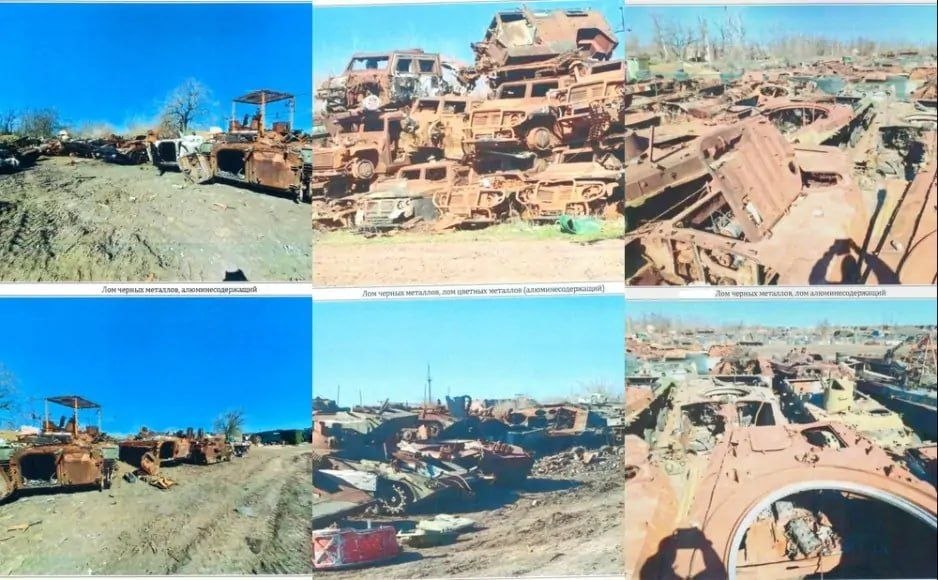
A post has appeared on Russian Telegram channels about the sale of more than 300 pieces of military equipment for scrap in the Rostov Region.
The equipment includes at least 46 tanks, as well as numerous BMPs, BTRs, engineering vehicles, and cars.
This sale does not involve the resale of equipment from storage depots, as those depots contain modern models.
For example, “Tiger” and “Lynx” armored vehicles, and even the notorious Chinese Desertcross golf carts.
The equipment includes at least 46 tanks, as well as numerous BMPs, BTRs, engineering vehicles, and cars.
This sale does not involve the resale of equipment from storage depots, as those depots contain modern models.
For example, “Tiger” and “Lynx” armored vehicles, and even the notorious Chinese Desertcross golf carts.
Vladimir Putin signed several laws, including:
✹ A law refusing to extradite foreigners who served on contract in the Russian army;
✹ A law establishing the Putin District Court in Grozny;
✹ A law imposing fines on website owners who allow users to log in using accounts from foreign services—such as Google and Apple;
✹ A second package of measures to combat fraud, which includes: the ability to block incoming international calls; the creation of a unified database of unique IMEI identifiers for mobile devices, linked to a “blacklist” of phones that have been stolen or illegally imported into Russia; and the requirement for telecom operators to label international calls.
✹ New restrictions on “foreign agents,” including a ban on placing public service announcements on their platforms.
✹ A law refusing to extradite foreigners who served on contract in the Russian army;
✹ A law establishing the Putin District Court in Grozny;
✹ A law imposing fines on website owners who allow users to log in using accounts from foreign services—such as Google and Apple;
✹ A second package of measures to combat fraud, which includes: the ability to block incoming international calls; the creation of a unified database of unique IMEI identifiers for mobile devices, linked to a “blacklist” of phones that have been stolen or illegally imported into Russia; and the requirement for telecom operators to label international calls.
✹ New restrictions on “foreign agents,” including a ban on placing public service announcements on their platforms.
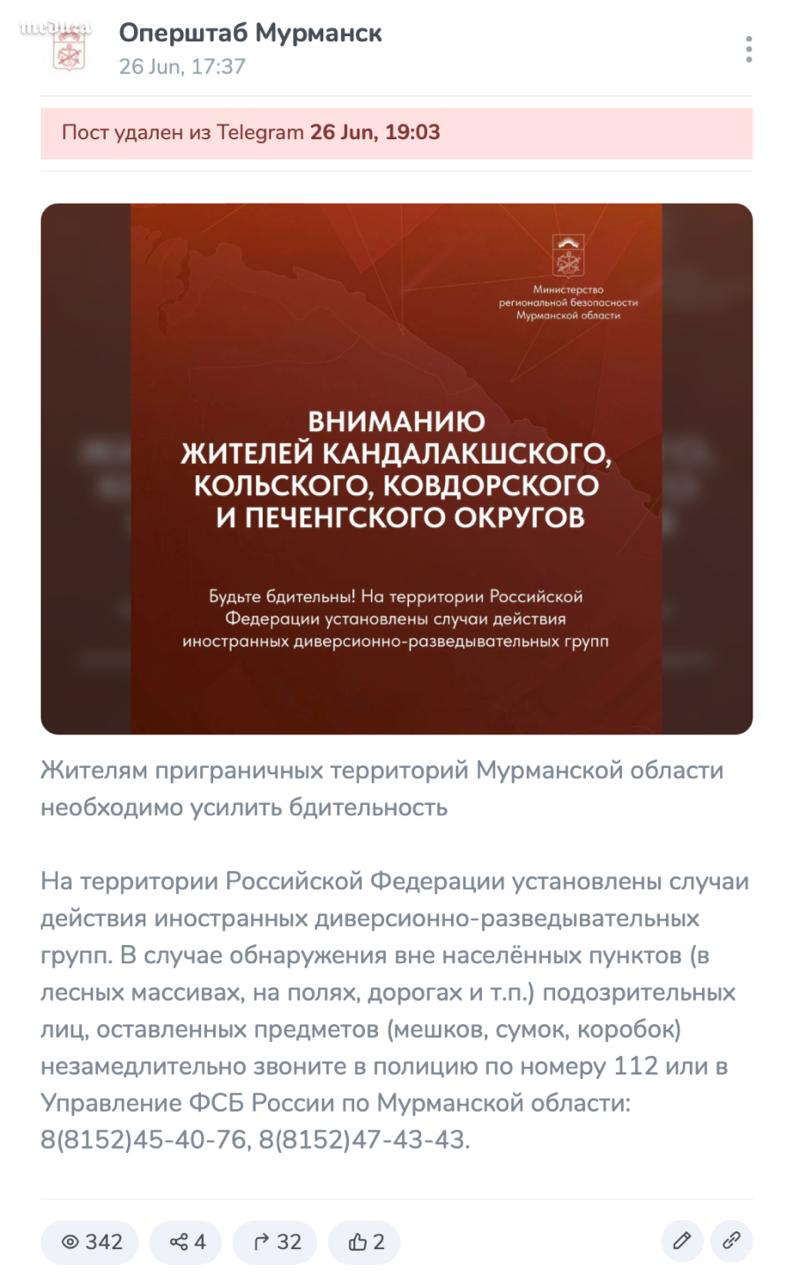
Residents of four border districts in the Murmansk Region have been urged to remain vigilant because “cases of foreign sabotage and reconnaissance groups operating in Russia have been confirmed.”
An hour and a half after it was published, the post was deleted from the Telegram channel.
An hour and a half after it was published, the post was deleted from the Telegram channel.
Deputy Minister of Culture Zhanna Alekseeva stated that the Russian State Library (formerly the Lenin Library) is creating a closed repository for “destructive” books. She even used the term “spetskhran”—a word reminiscent of the Soviet era—to refer to a section of banned literature accessible only to a select few.
Alekseeva also noted that Russian libraries no longer add works by “foreign agents” to their collections and, in general, if they purchase books with federal funds, they do so only based on recommended lists.
Journalist Sergei Buntman writes on his Telegram channel that 53 years ago he worked at the Lenin Library as a junior librarian and would occasionally find himself “at the gates of Spetskhran”—but access was denied to him: “They wouldn’t let us past the binders of banned Chinese newspapers and would kick us out.” “The next generation took the banned material back out,” Buntman recalls. “And that’s how it will be now: no political nonsense lasts forever.”
Alekseeva also noted that Russian libraries no longer add works by “foreign agents” to their collections and, in general, if they purchase books with federal funds, they do so only based on recommended lists.
Journalist Sergei Buntman writes on his Telegram channel that 53 years ago he worked at the Lenin Library as a junior librarian and would occasionally find himself “at the gates of Spetskhran”—but access was denied to him: “They wouldn’t let us past the binders of banned Chinese newspapers and would kick us out.” “The next generation took the banned material back out,” Buntman recalls. “And that’s how it will be now: no political nonsense lasts forever.”
Starting July 1, 2026, Russian authorities will suspend the “movement of persons, vehicles, goods, and cargo” through the following border crossings:
✹ Vyborg and Svetogorsk in the Leningrad Region (border with Finland);
✹ Värtsilä and Lütta in Karelia (border with Finland);
✹ St. Petersburg-Finlyandsky (border with Finland);
✹ Pechory-Pskovskie in the Pskov Region (border with Estonia);
✹ Pytalovo in the Pskov Region (border with Latvia).
No reason has been given as to why Russian authorities decided to close these border crossings. The duration of the restrictions has also not been specified.
However, since 2024, only the crossings in Pechory and Pytalovo have been operational. The border with Finland has long been closed by decision of the Finnish authorities.
✹ Vyborg and Svetogorsk in the Leningrad Region (border with Finland);
✹ Värtsilä and Lütta in Karelia (border with Finland);
✹ St. Petersburg-Finlyandsky (border with Finland);
✹ Pechory-Pskovskie in the Pskov Region (border with Estonia);
✹ Pytalovo in the Pskov Region (border with Latvia).
No reason has been given as to why Russian authorities decided to close these border crossings. The duration of the restrictions has also not been specified.
However, since 2024, only the crossings in Pechory and Pytalovo have been operational. The border with Finland has long been closed by decision of the Finnish authorities.
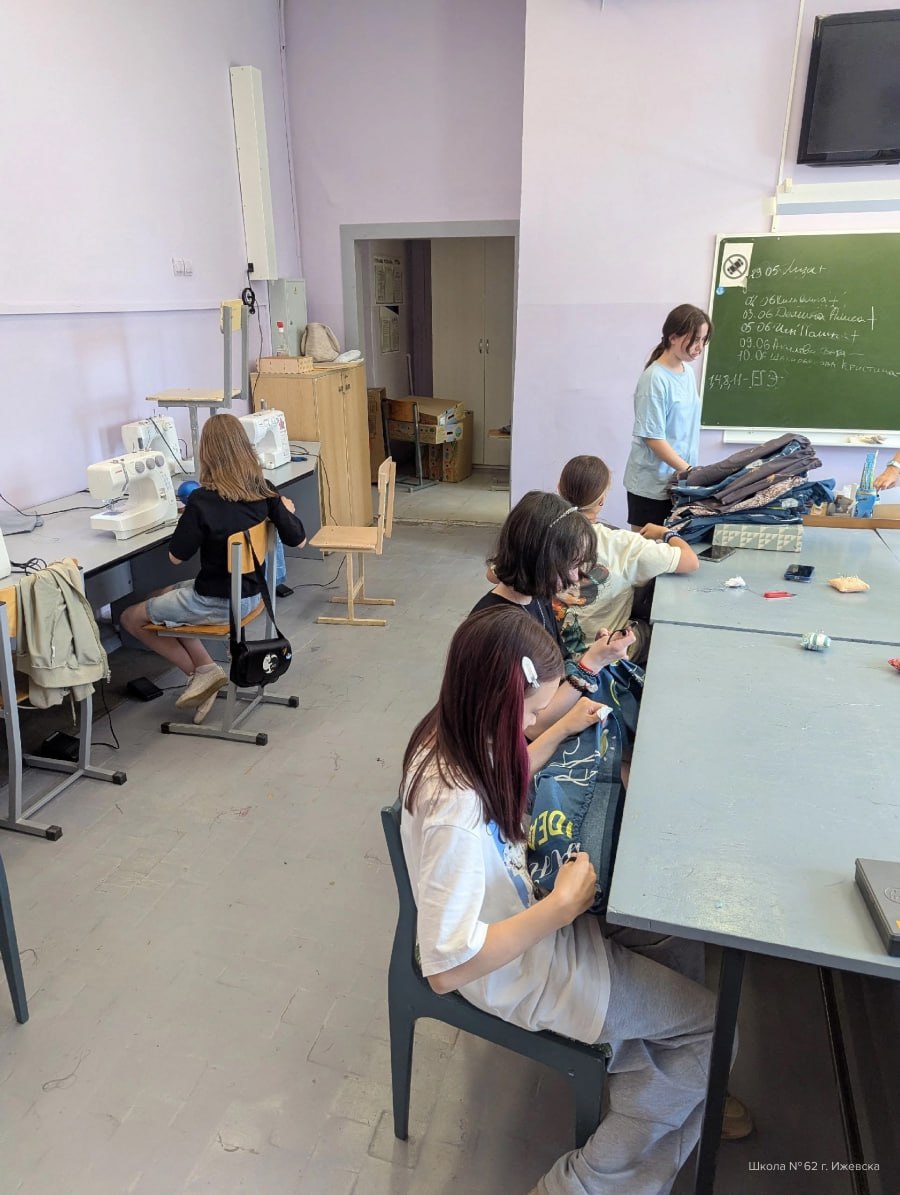
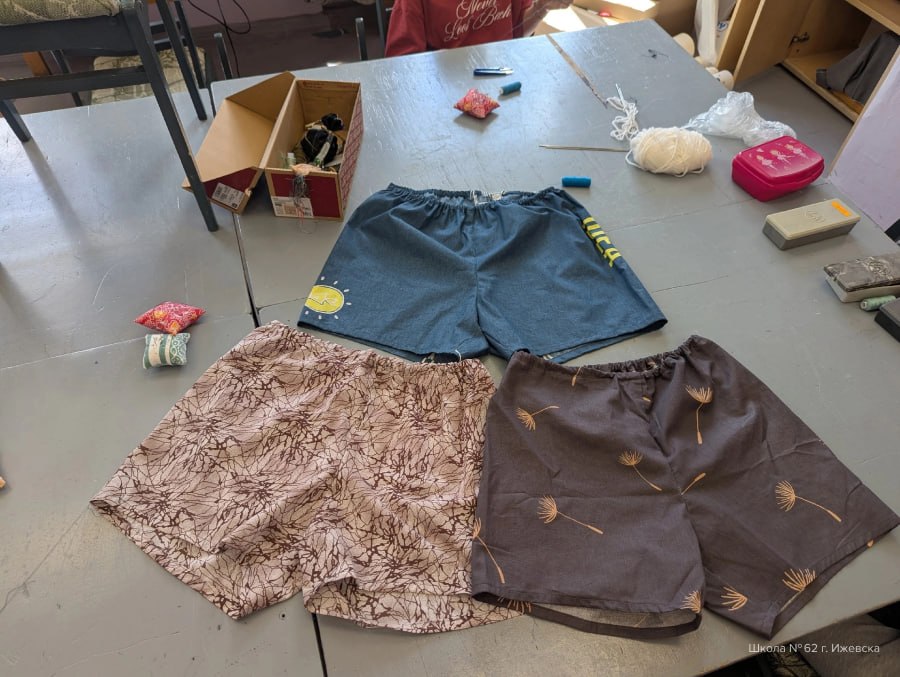
At School No. 62 in Izhevsk, 5th- and 6th-grade girls were enlisted to sew underwear for Russian soldiers participating in the war with Ukraine.
According to the school, the “Igolochka” sewing group produced a batch of “sewn items for soldiers in a regiment from Udmurtia.” Photos in the post show that the children were forced to sew underwear.
“The girls in grades 5 and 6 worked tirelessly for two weeks. <…> The girls made a meaningful contribution to helping people in need! These items will be sent to the front and will be useful to the soldiers,” the school noted.
In exchange for the shipment of underwear for the military, “Igolochka” received two letters of thanks.
According to the school, the “Igolochka” sewing group produced a batch of “sewn items for soldiers in a regiment from Udmurtia.” Photos in the post show that the children were forced to sew underwear.
“The girls in grades 5 and 6 worked tirelessly for two weeks. <…> The girls made a meaningful contribution to helping people in need! These items will be sent to the front and will be useful to the soldiers,” the school noted.
In exchange for the shipment of underwear for the military, “Igolochka” received two letters of thanks.
Banks in the Eurasian Economic Union (EAEU) have begun tightening the terms for depositing Russian rubles in cash starting in June 2026, according to RBC.
At least eight Belarusian banks have introduced a 2–5% fee for depositing cash rubles into checking accounts.
Kazakhstan’s Tsentrkredit Bank has introduced a 5% fee for accepting cash rubles at teller windows, terminals, and ATMs for non-residents.
In Kyrgyzstan, Ekoislamikbank has set a 5% fee for depositing cash rubles and for making SWIFT transfers.
In addition, some Armenian banks have suspended transactions involving Russian ruble cash, including deposits into accounts.
The introduction of these fees came amid a sharp increase in the inflow of cash from Russia. An RBC source attributed this to tighter controls on large transactions in Russia. Also, in late March, Vladimir Putin signed a decree prohibiting individuals from taking cash rubles out of Russia to other countries in amounts exceeding the equivalent of $100,000. An exception is made for the export of ruble cash through Russia’s international airports.
At least eight Belarusian banks have introduced a 2–5% fee for depositing cash rubles into checking accounts.
Kazakhstan’s Tsentrkredit Bank has introduced a 5% fee for accepting cash rubles at teller windows, terminals, and ATMs for non-residents.
In Kyrgyzstan, Ekoislamikbank has set a 5% fee for depositing cash rubles and for making SWIFT transfers.
In addition, some Armenian banks have suspended transactions involving Russian ruble cash, including deposits into accounts.
The introduction of these fees came amid a sharp increase in the inflow of cash from Russia. An RBC source attributed this to tighter controls on large transactions in Russia. Also, in late March, Vladimir Putin signed a decree prohibiting individuals from taking cash rubles out of Russia to other countries in amounts exceeding the equivalent of $100,000. An exception is made for the export of ruble cash through Russia’s international airports.
Food producers from the Volga Region and the Southern Federal District are sending letters to retail chains in St. Petersburg stating that they cannot guarantee delivery dates and asking that they not be fined for delays.
One supplier in the Ulyanovsk Region explicitly states that regional authorities have imposed restrictions on the sale of gasoline and diesel for trucks, and due to force majeure, trucks carrying goods are being delayed en route.
The problem is not limited to remote regions. In Karelia, there are no shortages of diesel itself, but the time it takes to refuel a truck has increased from ten minutes to two hours.
In settlements far from district centers, the situation is worse—only a few gas stations are operating there, and they may not have any fuel at all, which sometimes prevents a truck from returning after delivering its cargo.
One supplier in the Ulyanovsk Region explicitly states that regional authorities have imposed restrictions on the sale of gasoline and diesel for trucks, and due to force majeure, trucks carrying goods are being delayed en route.
The problem is not limited to remote regions. In Karelia, there are no shortages of diesel itself, but the time it takes to refuel a truck has increased from ten minutes to two hours.
In settlements far from district centers, the situation is worse—only a few gas stations are operating there, and they may not have any fuel at all, which sometimes prevents a truck from returning after delivering its cargo.

>>406706
Of course they can't leave. That's just how school is. Better for target audience to learn typical useful girl stuff at school than waste away learning math and other bullshit that won't help them raise a family.
Of course they can't leave. That's just how school is. Better for target audience to learn typical useful girl stuff at school than waste away learning math and other bullshit that won't help them raise a family.
>>406707
>That's just how school is
Anon, it's summer now. Technically, they can leave, because it's not lesson, but sewing club.
>That's just how school is
Anon, it's summer now. Technically, they can leave, because it's not lesson, but sewing club.
>>406707
either way they wouldn't have a job, it is a feudalism way to just waste your life with unnecessarily shit as long as possible , it's called population control.
because governments can't create that many jobs.
either way they wouldn't have a job, it is a feudalism way to just waste your life with unnecessarily shit as long as possible , it's called population control.
because governments can't create that many jobs.
>>406709
>either way they wouldn't have a job
Good. They shouldn't have one. They are girls. They should be able to live as homemaking mothers while easing the easing the efforts of their husband while he works to provide for his family with his own job.
>way to just waste your life with unnecessarily shit as long as possible , it's called population control.
Sure. Fostering a culture of nuclear family homemaking by teaching girls traditional feminine skills is "population control" in the sense that it will increase the quality and quantity of the population within a generation.
>either way they wouldn't have a job
Good. They shouldn't have one. They are girls. They should be able to live as homemaking mothers while easing the easing the efforts of their husband while he works to provide for his family with his own job.
>way to just waste your life with unnecessarily shit as long as possible , it's called population control.
Sure. Fostering a culture of nuclear family homemaking by teaching girls traditional feminine skills is "population control" in the sense that it will increase the quality and quantity of the population within a generation.
A court in Buryatia fined two inmates at IK-2 for displaying symbols of the “extremist movement” AUE, which the court classified as including the word “fart,” according to the publication “Versтка.”
According to the court rulings, inmates Sambu Radnabazarov and Alexander Goncharov were learning to write. They wrote “fart” and “With prisoner’s regards” on postcards. FSIN officials considered these words to be a display of the symbols of an extremist organization.
The inmates pleaded guilty. “I didn’t understand the meaning of these words. I understand now and will not use these expressions,” both rulings state. The court fined each prisoner 1,000 rubles.
———
AUE stands for “prisoners’ unity” or “prisoners’ Urkagan unity.” In 2020, the Supreme Court of the Russian Federation declared AUE an “extremist organization” and banned it.
According to the court rulings, inmates Sambu Radnabazarov and Alexander Goncharov were learning to write. They wrote “fart” and “With prisoner’s regards” on postcards. FSIN officials considered these words to be a display of the symbols of an extremist organization.
The inmates pleaded guilty. “I didn’t understand the meaning of these words. I understand now and will not use these expressions,” both rulings state. The court fined each prisoner 1,000 rubles.
———
AUE stands for “prisoners’ unity” or “prisoners’ Urkagan unity.” In 2020, the Supreme Court of the Russian Federation declared AUE an “extremist organization” and banned it.
The Leninsky Court in Yekaterinburg sentenced Alexei Sokolov to two years of forced labor, according to “Mediazona.”
The prosecution had sought a 3.5-year sentence in a penal colony for Sokolov.
Alexei Sokolov is a former member of the Sverdlovsk Region Public Monitoring Commission and co-founder of the organization “Ural Human Rights Defenders,” which helps prisoners challenge unlawful actions by Federal Penitentiary Service officials.
He was charged with displaying prohibited symbols for posting links to Facebook on the “Ural Human Rights Defenders” Telegram channel in 2020 and 2021.
Sokolov does not admit guilt. After his arrest, he reported being beaten during his detention and claimed his case was fabricated.
The prosecution had sought a 3.5-year sentence in a penal colony for Sokolov.
Alexei Sokolov is a former member of the Sverdlovsk Region Public Monitoring Commission and co-founder of the organization “Ural Human Rights Defenders,” which helps prisoners challenge unlawful actions by Federal Penitentiary Service officials.
He was charged with displaying prohibited symbols for posting links to Facebook on the “Ural Human Rights Defenders” Telegram channel in 2020 and 2021.
Sokolov does not admit guilt. After his arrest, he reported being beaten during his detention and claimed his case was fabricated.
The Telegram channel “We Can Explain” reported that the Russian Foreign Ministry is drafting a package of documents to introduce exit visas.
According to the channel, under the pretext of “the safety of Russian citizens,” there are plans to restrict travel to NATO countries. Tourists will be able to travel only along approved routes, in groups of ten or more, accompanied by a guide. The list of countries where individual tourism will be permitted has not yet been approved.
Russian Foreign Ministry spokesperson Maria Zakharova, in a comment to RBC, called the channel’s report “nonsense” and “a classic example of foreign agent activity.”
According to the channel, under the pretext of “the safety of Russian citizens,” there are plans to restrict travel to NATO countries. Tourists will be able to travel only along approved routes, in groups of ten or more, accompanied by a guide. The list of countries where individual tourism will be permitted has not yet been approved.
Russian Foreign Ministry spokesperson Maria Zakharova, in a comment to RBC, called the channel’s report “nonsense” and “a classic example of foreign agent activity.”
In Russia, cases have begun to be filed under the treason statute (Article 275 of the Criminal Code) for the use of paid reactions on Telegram, according to the Telegram channel “Prison Lawyer.” According to the channel, these are the first such cases in Russian judicial practice. The authors did not provide any details.
Previously, such cases were charged under the article on aiding terrorist activities (Article 205.1 of the Criminal Code). Like the treason provision, it carries penalties of up to life imprisonment.
“Mediazona” clarifies that the “Prison Lawyer” publication refers to cases in which “stars”—the virtual currency Telegram Stars—were sent to the channels of the “Russian Volunteer Corps” and the “Freedom of Russia” Legion. In Russia, both groups are listed as terrorist organizations.
The publication adds that proceedings in one treason case involving “Stars” began in 2026, while the donation was made in 2025.
Previously, such cases were charged under the article on aiding terrorist activities (Article 205.1 of the Criminal Code). Like the treason provision, it carries penalties of up to life imprisonment.
“Mediazona” clarifies that the “Prison Lawyer” publication refers to cases in which “stars”—the virtual currency Telegram Stars—were sent to the channels of the “Russian Volunteer Corps” and the “Freedom of Russia” Legion. In Russia, both groups are listed as terrorist organizations.
The publication adds that proceedings in one treason case involving “Stars” began in 2026, while the donation was made in 2025.
Gasoline production in Russia has fallen to 65% of average seasonal consumption following Ukrainian drone attacks on refineries, Reuters reports, citing two sources and its own calculations.
According to the agency, the shortfall in gasoline production compared to the volumes needed during the summer season (when demand from motorists increases) amounted to 35% (between 40,000 and 45,000 metric tons per day). In June, the daily shortfall stood at 25%.
According to industry sources, daily demand for gasoline in Russia during the peak summer consumption period ranges from 115,000 to 120,000 metric tons.
According to the agency, the shortfall in gasoline production compared to the volumes needed during the summer season (when demand from motorists increases) amounted to 35% (between 40,000 and 45,000 metric tons per day). In June, the daily shortfall stood at 25%.
According to industry sources, daily demand for gasoline in Russia during the peak summer consumption period ranges from 115,000 to 120,000 metric tons.
>>406943
>Gasoline production in Russia has fallen to 65%
For the record, Russiya just imported 400K tons of gasoline from India, the low IQ europeans were laughing at that without realizing that that volume of gas was mean to be delivered to the European Union. So, gas shortages are coming to Brussels.
>Gasoline production in Russia has fallen to 65%
For the record, Russiya just imported 400K tons of gasoline from India, the low IQ europeans were laughing at that without realizing that that volume of gas was mean to be delivered to the European Union. So, gas shortages are coming to Brussels.
[Reply] [Last 50 Posts] [Last 100 Posts] [Last 200 Posts]
You are viewing older replies. Click [View All] or [Last n Posts] to vew latest posts.
Clicking update will load all posts posted after last post on this page.
Post pagination: [Prev] [1-100] [101-200] [201-227] [Next] [Live (last 100 replies)]
227 replies | 56 files | 72 UUIDs | Page 1