>The online message board 4chan is being investigated by the UK communications regulator over failure to comply with recently introduced online safety rules.
>Ofcom says it has received complaints over potential illegal content on the website, which has not responded to its requests for information.
>Under the Online Safety Act, online services must assess the risk of UK users encountering illegal content and activity on their platforms, and take steps to protect them from it.
>Ofcom is also investigating porn provider First Time Videos over its age verification checks, and seven file sharing services over potential child sexual abuse material.
>4chan has been contacted for comment.
>Ofcom says it requested 4chan's risk assessment in April but has not had any response.
>The regulator will now investigate whether the platform "has failed, or is failing, to comply with its duties to protect its users from illegal content".
>It would not say what kind of illegal content it is investigating.
>Ofcom has the power to fine companies up to 10% of their global revenues, or £18m - whichever is the greater number.
>4chan has often been at the heart of online controversies in its 22 years, including misogynistic campaigns and conspiracy theories.
>Users are anonymous, which can often lead to extreme content being posted.
>It was the subject of an alleged hack earlier this year, which took parts of the website down for over a week.
The gilded cage for UK internet users is about to get much, much smaller.
https://web.archive.org/web/20250128165536/https://www.gov.uk/government/publications/online-safety-act-explainer/online-safety-act-explainer
/cyb/ - Cyberpunk Fiction and Fact
Cyberpunk is the idea that technology will condemn us to a future of totalitarian nightmares here you can discuss recent events and how technology has been used to facilitate greater control by the elites, or works of fiction
46 replies | 25 files | 34 UUIDs | Page 1

Anonymous
No.3709
>>3708
This makes me think about "the rules". Dictated by some, and enforced by some. In the end it is all about who has bigger guns.
This makes me think about "the rules". Dictated by some, and enforced by some. In the end it is all about who has bigger guns.
"I like Hitler's mustache" is illegal hate speech in the UK. A frog could croak in the woods and the UK government would begin investigating it for dangerous mouth sounds. If the UK doesn't think 4chan is properly following UK law, then the UK ought to block UK citizens from visiting 4chan. What right or capability do they have to fine 4chan anyway?
>Uhmm hey company from another country, you did a heckin racism so you need to pay a fine to our government, or.. or else!
What a bunch of fags!
>Uhmm hey company from another country, you did a heckin racism so you need to pay a fine to our government, or.. or else!
What a bunch of fags!
>>3710
>A frog could croak in the woods and the UK government would begin investigating it for dangerous mouth sounds.
Ha! Yeah thats about right.
>What right or capability do they have to fine 4chan anyway?
They don't, however that doesn't stop them from creating a dystopian, authoritarian 'superpower' in the pursuit of 'equality and child safety'. One of the major caveats of the Online Safety Act (other then its intentionally ambiguous phrasing) is the government wants to break end to end encryption for safety reasons. They tried this with Apple recently (https://www.bbc.co.uk/news/articles/c20g288yldkoto) the point that they even gave Apple a secret gag order (https://www.computerweekly.com/news/366620601/US-Congress-demands-UK-lifts-gag-on-Apple-encryption-order) to prevent them from informing users. They have no doubt done this with other companies, and we may never know for sure how said companies responded.
>A frog could croak in the woods and the UK government would begin investigating it for dangerous mouth sounds.
Ha! Yeah thats about right.
>What right or capability do they have to fine 4chan anyway?
They don't, however that doesn't stop them from creating a dystopian, authoritarian 'superpower' in the pursuit of 'equality and child safety'. One of the major caveats of the Online Safety Act (other then its intentionally ambiguous phrasing) is the government wants to break end to end encryption for safety reasons. They tried this with Apple recently (https://www.bbc.co.uk/news/articles/c20g288yldkoto) the point that they even gave Apple a secret gag order (https://www.computerweekly.com/news/366620601/US-Congress-demands-UK-lifts-gag-on-Apple-encryption-order) to prevent them from informing users. They have no doubt done this with other companies, and we may never know for sure how said companies responded.

Great.
Anonymous
No.3713

>>3711
>however that doesn't stop them from creating a dystopian, authoritarian 'superpower'
I really hope the UK to tight even more the budget and starve their shitkins on welfare. Then the lulz will begin for real.
>however that doesn't stop them from creating a dystopian, authoritarian 'superpower'
I really hope the UK to tight even more the budget and starve their shitkins on welfare. Then the lulz will begin for real.
Anonymous
No.3715

>>3714
Service uptime graph for various mobile (cell) providers, and Virgin, BT and Sky being the largest internet service providers in the UK (https://downdetector.co.uk/).
It's quite suspect that every single one has been having issues, which would suggest an infrastructure change further up the chain. It could be a minor misconfiguration, or it might be relation to a new General Act released (http://web.archive.org/web/20250621050227/https://www.legislation.gov.uk/ukpga/2025/18/enacted)
>An Act to make provision about access to customer data and business data; to make provision about services consisting of the use of information to ascertain and verify facts about individuals; to make provision about the recording and sharing, and keeping of registers, of information relating to apparatus in streets; to make provision about the keeping and maintenance of registers of births and deaths; to make provision for the regulation of the processing of information relating to identified or identifiable living individuals; to make provision about privacy and electronic communications; to establish the Information Commission; to make provision about information standards for health and social care; to make provision about the grant of smart meter communication licences; to make provision about the disclosure of information to improve public service delivery; to make provision about the retention of information by providers of internet services in connection with investigations into child deaths; to make provision about providing information for purposes related to the carrying out of independent research into online safety matters; to make provision about the retention of biometric data; to make provision about services for the provision of electronic signatures, electronic seals and other trust services; to make provision about works protected by copyright and the development of artificial intelligence systems; to make provision about the creation of purported intimate images; and for connected purposes.
Service uptime graph for various mobile (cell) providers, and Virgin, BT and Sky being the largest internet service providers in the UK (https://downdetector.co.uk/).
It's quite suspect that every single one has been having issues, which would suggest an infrastructure change further up the chain. It could be a minor misconfiguration, or it might be relation to a new General Act released (http://web.archive.org/web/20250621050227/https://www.legislation.gov.uk/ukpga/2025/18/enacted)
>An Act to make provision about access to customer data and business data; to make provision about services consisting of the use of information to ascertain and verify facts about individuals; to make provision about the recording and sharing, and keeping of registers, of information relating to apparatus in streets; to make provision about the keeping and maintenance of registers of births and deaths; to make provision for the regulation of the processing of information relating to identified or identifiable living individuals; to make provision about privacy and electronic communications; to establish the Information Commission; to make provision about information standards for health and social care; to make provision about the grant of smart meter communication licences; to make provision about the disclosure of information to improve public service delivery; to make provision about the retention of information by providers of internet services in connection with investigations into child deaths; to make provision about providing information for purposes related to the carrying out of independent research into online safety matters; to make provision about the retention of biometric data; to make provision about services for the provision of electronic signatures, electronic seals and other trust services; to make provision about works protected by copyright and the development of artificial intelligence systems; to make provision about the creation of purported intimate images; and for connected purposes.

WAR IS PEACE
FREEDOM IS SLAVERY
IGNORANCE IS STRENGTH
FREEDOM IS SLAVERY
IGNORANCE IS STRENGTH
>>3717
To be perfectly honest I've always thought 1984 was kind of an overrated book. At the same time I'm a little impressed at how effectively modern Britain has managed to emulate it, while simultaneously convincing its population that they're doing the opposite of emulating it.
To be perfectly honest I've always thought 1984 was kind of an overrated book. At the same time I'm a little impressed at how effectively modern Britain has managed to emulate it, while simultaneously convincing its population that they're doing the opposite of emulating it.
>>3718
It only seems overrated because we have since learned that people are so much worse than the characters depicted in the book. When Orwell wrote it in 1949 it was positively shocking.
It only seems overrated because we have since learned that people are so much worse than the characters depicted in the book. When Orwell wrote it in 1949 it was positively shocking.
Anonymous
No.3720

>>3718
>At the same time I'm a little impressed at how effectively modern Britain has managed to emulate it
The normies are going to norm. Every Single Time.
>At the same time I'm a little impressed at how effectively modern Britain has managed to emulate it
The normies are going to norm. Every Single Time.
Anonymous
No.3721
>>3719
The Overton Window has been moved underground, to a locked filing cabinet in a disused lavatory.
The Overton Window has been moved underground, to a locked filing cabinet in a disused lavatory.
Further bullshit
>Pornhub and a number of other major adult websites have confirmed they will introduce enhanced age checks for users from next month.
>Parent company Aylo says it is bringing in "government approved age assurance methods" but has not yet revealed how it will require users to prove they are over 18.
>Regulator Ofcom has previously said simply clicking a button, which is all the adult site currently requires, is not enough.
>Ofcom said the changes would "bring pornography into line with how we treat adult services in the real world."
>The Online Safety Act requires adult sites to introduce "robust" age checking techniques by this summer.
>Approved measures include demanding photo ID or running credit card checks before users can view sexually explicit material.
>"Society has long protected youngsters from products that aren't suitable for them, from alcohol to smoking or gambling," said Oliver Griffiths, Ofcom's group director of online safety, in a statement.
>"For too long children have been only a click away from harmful pornography online."
>Mr Griffiths said assurances from Aylo and several other porn providers, including Stripchat and Streamate, regarding the introduction of new age checks showed "change is happening".
>The regulator said its recent research indicated 8% of children aged 8-14 in the UK had visited an online porn site or app over a 28-day period.
>This included about 3% of eight to nine year olds, its survey suggests.
>"We know that highly effective age assurance can play a vital role in protecting young users from accessing harmful and inappropriate material on social media and other platforms," said Rani Govender, policy manager for child safety online at the NSPCC.
>"It is time tech companies take responsibility for ensuring children have safe, age-appropriate experiences online, and we welcome the progress that Ofcom are making in this space."
...
>Under the Online Safety Act, providers of platforms where children could encounter porn and harmful content must have measures in place to stop them accessing it.
>The Act requires this to take place chiefly through the use of technology that is "highly effective" in determining whether a user is 18.
>Ofcom said in January, external this could include solutions such as photo ID matching, digital identity services or facial age estimation.
>Porn providers that fail to meet the Act's requirements could face enforcement action such as huge fines.
https://web.archive.org/web/20250626114338/https://www.bbc.com/news/articles/cr5v2lz5vl6o
>Pornhub and a number of other major adult websites have confirmed they will introduce enhanced age checks for users from next month.
>Parent company Aylo says it is bringing in "government approved age assurance methods" but has not yet revealed how it will require users to prove they are over 18.
>Regulator Ofcom has previously said simply clicking a button, which is all the adult site currently requires, is not enough.
>Ofcom said the changes would "bring pornography into line with how we treat adult services in the real world."
>The Online Safety Act requires adult sites to introduce "robust" age checking techniques by this summer.
>Approved measures include demanding photo ID or running credit card checks before users can view sexually explicit material.
>"Society has long protected youngsters from products that aren't suitable for them, from alcohol to smoking or gambling," said Oliver Griffiths, Ofcom's group director of online safety, in a statement.
>"For too long children have been only a click away from harmful pornography online."
>Mr Griffiths said assurances from Aylo and several other porn providers, including Stripchat and Streamate, regarding the introduction of new age checks showed "change is happening".
>The regulator said its recent research indicated 8% of children aged 8-14 in the UK had visited an online porn site or app over a 28-day period.
>This included about 3% of eight to nine year olds, its survey suggests.
>"We know that highly effective age assurance can play a vital role in protecting young users from accessing harmful and inappropriate material on social media and other platforms," said Rani Govender, policy manager for child safety online at the NSPCC.
>"It is time tech companies take responsibility for ensuring children have safe, age-appropriate experiences online, and we welcome the progress that Ofcom are making in this space."
...
>Under the Online Safety Act, providers of platforms where children could encounter porn and harmful content must have measures in place to stop them accessing it.
>The Act requires this to take place chiefly through the use of technology that is "highly effective" in determining whether a user is 18.
>Ofcom said in January, external this could include solutions such as photo ID matching, digital identity services or facial age estimation.
>Porn providers that fail to meet the Act's requirements could face enforcement action such as huge fines.
https://web.archive.org/web/20250626114338/https://www.bbc.com/news/articles/cr5v2lz5vl6o
Anonymous
No.3724
>>3722
Sounds as if they are planning to track who is using those sites.
Probably going to put them on a government watch list of some kind.
Wind up being hauled in for questioning anytime someone complains that some creep waved their tallywhacker at a kid.
Sounds as if they are planning to track who is using those sites.
Probably going to put them on a government watch list of some kind.
Wind up being hauled in for questioning anytime someone complains that some creep waved their tallywhacker at a kid.

>As of 25 July 2025, all sites and apps that allow pornography will need to have strong age checks in place, to make sure children can’t access that or other harmful content.
>This is a significant change to how adults in the UK access pornography, and is a key step in helping to protect children from harmful content when they’re online.
>We understand there are some questions about how the new rules will work. So, we’ve put together this explainer to clear things up for people in the UK who use these online services.
<Why are these new rules being introduced?
>The rules are being introduced under the Online Safety Act. Ofcom is the UK’s regulator for online safety, and keeping children safe when they’re online is a priority for us.
>Until now, it’s been too easy for children to see harmful content, including pornography online. New research from Ofcom has found that eight per cent of children aged 8-14 in the UK visited an online porn site or app in a month – including around 3% of 8–9-year-olds – the youngest children in the study.
>Boys aged 13-14 were mostly likely to visit a porn service, significantly more than girls the same age. With older teenagers also likely accessing pornography, the total number of under-18s exposed to adult content will be higher still.
>Our research also shows that the vast majority of adults (80%) support age checks on online pornographic sites as a means of protecting children.
>As the regulator, we won’t be assessing individual pieces of content, or telling online services to remove legal material. Our role is not to stop adults from accessing legal pornography, but from 25 July stronger checks will be needed and crucially, just ticking a box to say you're over 18 will no longer be enough.
>As well as pornography, we expect the riskiest services to use strong age checks to protect children from suicide, self-harm and eating disorder content and other types of harmful content, while preserving adults’ rights to access legal content.
<How will this affect me as a user?
>When you visit a site or app that allows pornography, you shouldn’t be able to see this content before you’re asked to confirm your age.
>To make the experience more accessible and transparent, you should be able to read a statement setting out the kinds of age checks that you can use, and how they work.
>To comply with Ofcom’s rules, the age check process should be technically accurate, robust, reliable and fair.
<And how will I prove my age?
>There’s a number of methods a site or app might use to ask you to confirm your age. They might do this check themselves or use another company to do the check. These methods include:
<Facial age estimation:
>you show your face via photo or video, and technology analyses it to estimate your age.
<Open banking:
>you give permission for the age-check service to securely access information from your bank about whether you are over 18. The age-check service then confirms this with the site or app.
<Digital identity services:
>these include digital identity wallets, which can securely store and share information which proves your age in a digital format.
<Credit card age checks
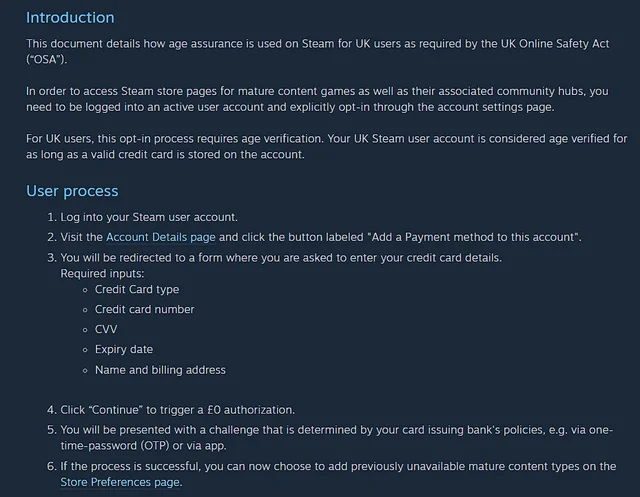
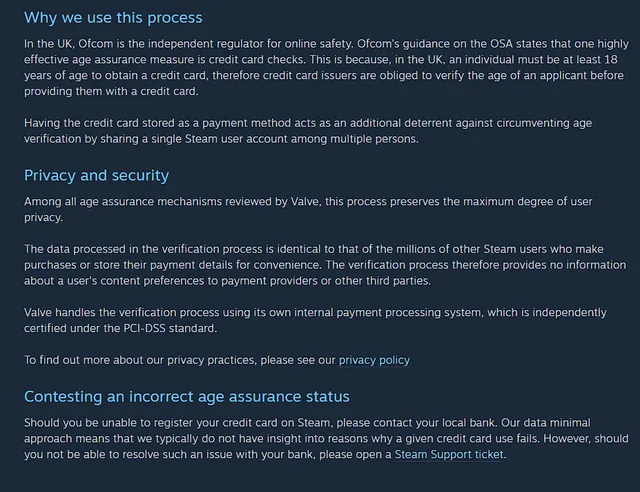
>you provide your credit card details and a payment processor checks if the card is valid. As you must be over 18 to obtain a credit card this shows you are over 18.
<Email-based age estimation:
>you provide your email address, and technology analyses other online services where it has been used – such as banking or utility providers - to estimate your age.
<Mobile network operator age checks
>you give your permission for an age-check service to confirm whether or not your mobile phone number has age filters applied to it. If there are no restrictions, this confirms you are over 18.
<Photo-ID matching
>this is similar to a check when you show a document. For example, you upload an image of a document that shows your face and age, and an image of yourself at the same time – these are compared to confirm if the document is yours.
<How will Ofcom enforce the new rules?
>We expect sites and apps to engage with us and comply with their duties under our new rules.
>If they don’t, we can impose fines of up to £18m or 10% of their qualifying worldwide revenue (whichever is greater). And in the most serious cases, we can ask a court to impose sanctions on third parties, such as internet providers, which could lead to the site being blocked or restricted in the UK.
https://web.archive.org/web/20250711040210/https://www.ofcom.org.uk/online-safety/protecting-children/age-checks-for-online-safety--what-you-need-to-know-as-a-user
>This is a significant change to how adults in the UK access pornography, and is a key step in helping to protect children from harmful content when they’re online.
>We understand there are some questions about how the new rules will work. So, we’ve put together this explainer to clear things up for people in the UK who use these online services.
<Why are these new rules being introduced?
>The rules are being introduced under the Online Safety Act. Ofcom is the UK’s regulator for online safety, and keeping children safe when they’re online is a priority for us.
>Until now, it’s been too easy for children to see harmful content, including pornography online. New research from Ofcom has found that eight per cent of children aged 8-14 in the UK visited an online porn site or app in a month – including around 3% of 8–9-year-olds – the youngest children in the study.
>Boys aged 13-14 were mostly likely to visit a porn service, significantly more than girls the same age. With older teenagers also likely accessing pornography, the total number of under-18s exposed to adult content will be higher still.
>Our research also shows that the vast majority of adults (80%) support age checks on online pornographic sites as a means of protecting children.
>As the regulator, we won’t be assessing individual pieces of content, or telling online services to remove legal material. Our role is not to stop adults from accessing legal pornography, but from 25 July stronger checks will be needed and crucially, just ticking a box to say you're over 18 will no longer be enough.
>As well as pornography, we expect the riskiest services to use strong age checks to protect children from suicide, self-harm and eating disorder content and other types of harmful content, while preserving adults’ rights to access legal content.
<How will this affect me as a user?
>When you visit a site or app that allows pornography, you shouldn’t be able to see this content before you’re asked to confirm your age.
>To make the experience more accessible and transparent, you should be able to read a statement setting out the kinds of age checks that you can use, and how they work.
>To comply with Ofcom’s rules, the age check process should be technically accurate, robust, reliable and fair.
<And how will I prove my age?
>There’s a number of methods a site or app might use to ask you to confirm your age. They might do this check themselves or use another company to do the check. These methods include:
<Facial age estimation:
>you show your face via photo or video, and technology analyses it to estimate your age.
<Open banking:
>you give permission for the age-check service to securely access information from your bank about whether you are over 18. The age-check service then confirms this with the site or app.
<Digital identity services:
>these include digital identity wallets, which can securely store and share information which proves your age in a digital format.
<Credit card age checks
>you provide your credit card details and a payment processor checks if the card is valid. As you must be over 18 to obtain a credit card this shows you are over 18.
<Email-based age estimation:
>you provide your email address, and technology analyses other online services where it has been used – such as banking or utility providers - to estimate your age.
<Mobile network operator age checks
>you give your permission for an age-check service to confirm whether or not your mobile phone number has age filters applied to it. If there are no restrictions, this confirms you are over 18.
<Photo-ID matching
>this is similar to a check when you show a document. For example, you upload an image of a document that shows your face and age, and an image of yourself at the same time – these are compared to confirm if the document is yours.
<How will Ofcom enforce the new rules?
>We expect sites and apps to engage with us and comply with their duties under our new rules.
>If they don’t, we can impose fines of up to £18m or 10% of their qualifying worldwide revenue (whichever is greater). And in the most serious cases, we can ask a court to impose sanctions on third parties, such as internet providers, which could lead to the site being blocked or restricted in the UK.
https://web.archive.org/web/20250711040210/https://www.ofcom.org.uk/online-safety/protecting-children/age-checks-for-online-safety--what-you-need-to-know-as-a-user
Anonymous
No.3755
>kids prevented from watching porn, playing multiplayer games, and chatting with friends online
>get bored, go outside
>get raped by shitskins in the park
>get bored, go outside
>get raped by shitskins in the park
>>3754
Maybe US anons could offer UK anons citizenship through fake gay marriage... for a fee of course.
Maybe US anons could offer UK anons citizenship through fake gay marriage... for a fee of course.
Anonymous
No.3757


Anonymous
No.3760


Even Civitai has fallen
>As of 11:59pm UTC on the 24th July 2025, users located in England, Scotland, Wales, and Northern Ireland will no longer be able to access Civitai.
>We know this is deeply disappointing news, and we're tremendously sorry to our UK community. You've been an important and valued part of our platform since inception, and we're heartbroken to have to take such a drastic step. This decision wasn't taken lightly, and we want to be transparent about why it's necessary.
<The Online Safety Act (OSA) Is a Serious Compliance Burden
>The UK government has enacted the Online Safety Act (OSA), a sweeping new law that governs any online service accessible to UK users - even those hosted abroad. If your platform allows user-generated content (as ours does), you're required to comply.
>This law is not limited to big tech. It explicitly applies to platforms of all sizes, including small companies like ours. It doesn’t matter where we're based.The moment a UK user can access our site, we're on the hook.
>The law requires:
< Two complex legal risk assessments (on illegal content and children's access)
< Ongoing compliance documentation and auditing
< Age verification systems, requiring intrusive biometric ID checks
< Expanded moderation requirements, and the removal of new categories of content, under the UK's Extreme Pornography legislation.
>If that sounds like a lot, it is. The law itself is over 250 pages long, and the regulatory guidance from Ofcom - the UK enforcement agency - is currently over 3,000 pages. It is legalese-laden, cross-referenced, and constantly shifting.
>We’re a small team. We simply don’t have the legal budget or manpower to decode and implement this. Attempting to comply without expert legal counsel would be reckless, and if we get it wrong...
>The Penalties Are Real - And Personal
>Non-compliance with the OSA is no joke. Ofcom has the power to levy fines of up to £18 million or 10% of global revenue, whichever is greater.
>These fines aren't a threat; they're being applied to platforms now. In March, after the first requirements of the Bill came into effect, Ofcom fined OnlyFans £1.05 million for failing to adequately explain their age-assurance measures.
>More chillingly, company directors and designated managers can face personal criminal liability if Ofcom determines we failed in our child safety or moderation duties. The law empowers Ofcom to act without warning: their first contact with a platform can be a formal breach notice with enforcement action attached. We cannot risk this level of liability.
<Can't We Just Fly Under the Radar?
>Unfortunately, no. We're already on it. We've had multiple meetings with the UK Home Office to defend the legitimacy of our AI-generated content and protect creative freedom. We’re not an unknown startup. Civitai is known to UK regulators, and pretending we can remain invisible simply isn't realistic.
<Why Not Just Comply?
>We wish we could. But the truth is, this law was written with massive tech firms in mind, not modest teams like ours. It requires constant legal review, multi-layered moderation systems beyond those we have in place now, and deep regulatory expertise. To do this responsibly and effectively would require hundreds of hours and tens of thousands of dollars in legal fees. It's not just a few policies - these sorts of obligations require a full-time legal team, and expanded moderation team which we can't afford.
<What Happens Next
>At the deadline, UK users will begin seeing a block message when visiting Civitai from within the blocked territories.
<To Our UK Community
>We're truly sorry. This situation is deeply frustrating, and a geoblock was our last possible option. We care about this space, and we care about our users.
>We hope the regulatory climate changes in the future, and if and when it does, we’ll reassess our ability to reopen access to the UK. That said, if recent legislation is any indication - such as proposals to further restrict even consensual adult content - we worry that the trend may be moving in the opposite direction.
>Until then, thank you for everything. This is goodbye - for now.
<FAQ
>Q: Can’t you just block minors or adult content and keep the site running in the UK?
<: No. The law applies to any platform that allows user-generated content and is accessible in the UK - regardless of whether it's kid-friendly or not. If UK users can access the platform, we are obligated to comply.
>Q: I’m in the UK and I’m furious. What can I do?
<A: We understand - we’re upset too. If you’re a UK citizen, we encourage you to reach out to your MP and make your concerns known about how the Online Safety Act impacts access to legitimate art, technology, and online communities.
>Q: Will you offer refunds to UK users?
<A: Yes. UK users who have recently purchased Buzz, a Annual Membership, or pre-paid Membership packages from BuyBuzz.io can contact our Support Portal for a refund of any unspent Buzz.
>>3762
Forgot context. Derp.
>As of 11:59pm UTC on the 24th July 2025, users located in England, Scotland, Wales, and Northern Ireland will no longer be able to access Civitai.
>We know this is deeply disappointing news, and we're tremendously sorry to our UK community. You've been an important and valued part of our platform since inception, and we're heartbroken to have to take such a drastic step. This decision wasn't taken lightly, and we want to be transparent about why it's necessary.
<The Online Safety Act (OSA) Is a Serious Compliance Burden
>The UK government has enacted the Online Safety Act (OSA), a sweeping new law that governs any online service accessible to UK users - even those hosted abroad. If your platform allows user-generated content (as ours does), you're required to comply.
>This law is not limited to big tech. It explicitly applies to platforms of all sizes, including small companies like ours. It doesn’t matter where we're based.The moment a UK user can access our site, we're on the hook.
>The law requires:
< Two complex legal risk assessments (on illegal content and children's access)
< Ongoing compliance documentation and auditing
< Age verification systems, requiring intrusive biometric ID checks
< Expanded moderation requirements, and the removal of new categories of content, under the UK's Extreme Pornography legislation.
>If that sounds like a lot, it is. The law itself is over 250 pages long, and the regulatory guidance from Ofcom - the UK enforcement agency - is currently over 3,000 pages. It is legalese-laden, cross-referenced, and constantly shifting.
>We’re a small team. We simply don’t have the legal budget or manpower to decode and implement this. Attempting to comply without expert legal counsel would be reckless, and if we get it wrong...
>The Penalties Are Real - And Personal
>Non-compliance with the OSA is no joke. Ofcom has the power to levy fines of up to £18 million or 10% of global revenue, whichever is greater.
>These fines aren't a threat; they're being applied to platforms now. In March, after the first requirements of the Bill came into effect, Ofcom fined OnlyFans £1.05 million for failing to adequately explain their age-assurance measures.
>More chillingly, company directors and designated managers can face personal criminal liability if Ofcom determines we failed in our child safety or moderation duties. The law empowers Ofcom to act without warning: their first contact with a platform can be a formal breach notice with enforcement action attached. We cannot risk this level of liability.
<Can't We Just Fly Under the Radar?
>Unfortunately, no. We're already on it. We've had multiple meetings with the UK Home Office to defend the legitimacy of our AI-generated content and protect creative freedom. We’re not an unknown startup. Civitai is known to UK regulators, and pretending we can remain invisible simply isn't realistic.
<Why Not Just Comply?
>We wish we could. But the truth is, this law was written with massive tech firms in mind, not modest teams like ours. It requires constant legal review, multi-layered moderation systems beyond those we have in place now, and deep regulatory expertise. To do this responsibly and effectively would require hundreds of hours and tens of thousands of dollars in legal fees. It's not just a few policies - these sorts of obligations require a full-time legal team, and expanded moderation team which we can't afford.
<What Happens Next
>At the deadline, UK users will begin seeing a block message when visiting Civitai from within the blocked territories.
<To Our UK Community
>We're truly sorry. This situation is deeply frustrating, and a geoblock was our last possible option. We care about this space, and we care about our users.
>We hope the regulatory climate changes in the future, and if and when it does, we’ll reassess our ability to reopen access to the UK. That said, if recent legislation is any indication - such as proposals to further restrict even consensual adult content - we worry that the trend may be moving in the opposite direction.
>Until then, thank you for everything. This is goodbye - for now.
<FAQ
>Q: Can’t you just block minors or adult content and keep the site running in the UK?
<: No. The law applies to any platform that allows user-generated content and is accessible in the UK - regardless of whether it's kid-friendly or not. If UK users can access the platform, we are obligated to comply.
>Q: I’m in the UK and I’m furious. What can I do?
<A: We understand - we’re upset too. If you’re a UK citizen, we encourage you to reach out to your MP and make your concerns known about how the Online Safety Act impacts access to legitimate art, technology, and online communities.
>Q: Will you offer refunds to UK users?
<A: Yes. UK users who have recently purchased Buzz, a Annual Membership, or pre-paid Membership packages from BuyBuzz.io can contact our Support Portal for a refund of any unspent Buzz.
>>3762
Forgot context. Derp.
>>3765
They're creating their own great firewall out of negative space, forcing others to make it for them instead of putting it up themselves, aren't they?
They're creating their own great firewall out of negative space, forcing others to make it for them instead of putting it up themselves, aren't they?
>>3766
>forcing others to make it for them instead of putting it up themselves, aren't they?
England lives and marches on, shambling like a zombie controlled by parasitic fungus....
>forcing others to make it for them instead of putting it up themselves, aren't they?
England lives and marches on, shambling like a zombie controlled by parasitic fungus....
>>3767
I'm a little surprised it took this long. Tha Yookay has been an open-air concentration camp for decades. Arresting people for posting memes without a loicense isn't a joke any more. It hasn't been for a while now.
Also, and this will be on the finals: everything the government there is doing to the native population, Leftists here want to do to us.
I'm a little surprised it took this long. Tha Yookay has been an open-air concentration camp for decades. Arresting people for posting memes without a loicense isn't a joke any more. It hasn't been for a while now.
Also, and this will be on the finals: everything the government there is doing to the native population, Leftists here want to do to us.
>>3771
...It's a politics-based 4chan spinoff. There will be meme spellings of country names.
>sigh
Okay Shaniqua, take a vibe break.
...It's a politics-based 4chan spinoff. There will be meme spellings of country names.
>sigh
Okay Shaniqua, take a vibe break.
Anonymous
No.3775
>>3773
>twatter
Even here, I can't escape that forced meme.
>*shits pants*
This is neuroticism manifest.
>twatter
Even here, I can't escape that forced meme.
>*shits pants*
This is neuroticism manifest.
Anonymous
No.3776
<What is happening on 25 July?
>Companies within the scope of the act must introduce safety measures to protect children from harmful content. This means all pornography sites must have in place rigorous age-checking procedures. Ofcom, the UK communications regulator and the act’s enforcer, found that 8% of children aged eight to 14 had visited an online pornography site or app over a month-long period.
>Social media platforms and large search engines must also prevent children from accessing pornography and material that promotes or encourages suicide, self-harm and eating disorders. This has to be kept off children’s feeds entirely. Hundreds of companies are affected by the rules.
>Platforms will also have to suppress the spread of other forms of material potentially harmful to children including the promotion of dangerous stunts, encouraging the use of harmful substances and enabling bullying.
<What are the recommended safety measures?
>Measures under the codes include: algorithms that recommend content to users must filter out harmful material; all sites and apps must have procedures for taking down dangerous content quickly; and children must have a “straightforward” way to report concerns. Adherence is not mandatory if companies believe they have valid alternative measures to meet their child safety obligations.
>The “riskiest” services, which include big social media platforms, could be required to use “highly effective” age checks to identify under-18 users. If social media platforms that contain harmful content do not introduce age checks, they will need to ensure there is a “child appropriate” experience on the site.
>X has said if it is unable to determine whether a user is 18 or over, they will be defaulted into sensitive content settings and will not be able to view adult material. It is also introducing age estimation technology and ID checks to verify if users are under 18. Meta, the owner of Instagram and Facebook, says it already has a multilayered approach to age checking. This includes its teen account feature – a default setting for anyone under 18 – that it says already provides an “age appropriate” experience for young users.
>Mark Jones, a partner at the law firm Payne Hicks Beach, said: “Ultimately it is going to be for Ofcom to decide whether these measures meet the requirements under the OSA [Online Safety Act] and, if not, to hold the companies to account.”
>The Molly Rose Foundation, a charity established by the family of the British teenager Molly Russell, who took her own life in 2017 after viewing harmful content online, said the measures did not go far enough. It has called for additional changes such as blocking dangerous online challenges and requiring platforms to proactively search for, and take down, depressive and body image-related content.
<How would age verification work?
>Age assurance measures for pornography providers supported by Ofcom include: facial age estimation, which assesses a person’s likely age through a live photo or video; checking a person’s age via their credit card provider, bank or mobile phone network operator; photo ID matching, where a passport or similar ID is checked against a selfie; or a “digital identity wallet” that contains proof of age.
>Ria Moody, a lawyer at the law firm Linklaters, said: “Age assurance measures must be very accurate. Ofcom has said that self-declaration of age, or terms of service saying users must be over 18, are not highly effective measures and so platforms should not rely on these alone.”
<What does that mean in practice?
>Pornhub, the most-visited provider of online pornography to the UK, has said it will introduce “regulator approved age assurance methods” by Friday. It has yet to say what these methods will be. OnlyFans, another site which carries pornography, already uses facial age verification software. It does not store an image of the user’s face but estimates age using data taken from millions of other images. A company called Yoti provides that software and also does so for Instagram.
>Reddit started checking ages last week for its forums and threads which include mature content. It is using technology made by a company called Persona, which verifies age through an uploaded selfie or a photo of government ID. Reddit does not have access to the photos but stores the verification status to avoid users having to repeat the process too often.
<How accurate is facial age verification?
>Software allows a website or app to set a “challenge” age – such as 20 or 25 – to limit the number of underage people who slip through the net. When Yoti set a challenge age of 20, fewer than 1% of 13- to 17-year-olds were incorrectly let through.
<What other methods are there?
>An equally direct method is to require users to show a piece of formal identification such as a passport or a driving licence. Again, the ID details do not need to be stored and can be used solely to verify access.
Will every site carrying pornography carry out the age checks?
>They should, but many smaller sites are expected to try ignoring the rule, fearing it will damage demand for their services. Industry insiders say that those ignoring the rules may wait to see how Ofcom responds to breaches before deciding how to act.
<How will the child protection measures be enforced?
>Ofcom can deploy a range of punishments under the act. Companies can be fined up to £18m or 10% of global turnover for breaches, or whichever is greater. In the case of Meta, such a fine would equate to $16bn. Sites or apps can also receive formal warnings. For extreme breaches, Ofcom can ask a court to prevent the site or app from being available in the UK.
>Senior managers at tech companies will also be criminally liable for repeated breaches of their duty of care to children and could face up to two years in jail if they ignore enforcement notices from Ofcom.
https://www.theguardian.com/technology/2025/jul/24/what-are-the-new-uk-online-safety-rules-and-how-will-they-be-enforced
>Companies within the scope of the act must introduce safety measures to protect children from harmful content. This means all pornography sites must have in place rigorous age-checking procedures. Ofcom, the UK communications regulator and the act’s enforcer, found that 8% of children aged eight to 14 had visited an online pornography site or app over a month-long period.
>Social media platforms and large search engines must also prevent children from accessing pornography and material that promotes or encourages suicide, self-harm and eating disorders. This has to be kept off children’s feeds entirely. Hundreds of companies are affected by the rules.
>Platforms will also have to suppress the spread of other forms of material potentially harmful to children including the promotion of dangerous stunts, encouraging the use of harmful substances and enabling bullying.
<What are the recommended safety measures?
>Measures under the codes include: algorithms that recommend content to users must filter out harmful material; all sites and apps must have procedures for taking down dangerous content quickly; and children must have a “straightforward” way to report concerns. Adherence is not mandatory if companies believe they have valid alternative measures to meet their child safety obligations.
>The “riskiest” services, which include big social media platforms, could be required to use “highly effective” age checks to identify under-18 users. If social media platforms that contain harmful content do not introduce age checks, they will need to ensure there is a “child appropriate” experience on the site.
>X has said if it is unable to determine whether a user is 18 or over, they will be defaulted into sensitive content settings and will not be able to view adult material. It is also introducing age estimation technology and ID checks to verify if users are under 18. Meta, the owner of Instagram and Facebook, says it already has a multilayered approach to age checking. This includes its teen account feature – a default setting for anyone under 18 – that it says already provides an “age appropriate” experience for young users.
>Mark Jones, a partner at the law firm Payne Hicks Beach, said: “Ultimately it is going to be for Ofcom to decide whether these measures meet the requirements under the OSA [Online Safety Act] and, if not, to hold the companies to account.”
>The Molly Rose Foundation, a charity established by the family of the British teenager Molly Russell, who took her own life in 2017 after viewing harmful content online, said the measures did not go far enough. It has called for additional changes such as blocking dangerous online challenges and requiring platforms to proactively search for, and take down, depressive and body image-related content.
<How would age verification work?
>Age assurance measures for pornography providers supported by Ofcom include: facial age estimation, which assesses a person’s likely age through a live photo or video; checking a person’s age via their credit card provider, bank or mobile phone network operator; photo ID matching, where a passport or similar ID is checked against a selfie; or a “digital identity wallet” that contains proof of age.
>Ria Moody, a lawyer at the law firm Linklaters, said: “Age assurance measures must be very accurate. Ofcom has said that self-declaration of age, or terms of service saying users must be over 18, are not highly effective measures and so platforms should not rely on these alone.”
<What does that mean in practice?
>Pornhub, the most-visited provider of online pornography to the UK, has said it will introduce “regulator approved age assurance methods” by Friday. It has yet to say what these methods will be. OnlyFans, another site which carries pornography, already uses facial age verification software. It does not store an image of the user’s face but estimates age using data taken from millions of other images. A company called Yoti provides that software and also does so for Instagram.
>Reddit started checking ages last week for its forums and threads which include mature content. It is using technology made by a company called Persona, which verifies age through an uploaded selfie or a photo of government ID. Reddit does not have access to the photos but stores the verification status to avoid users having to repeat the process too often.
<How accurate is facial age verification?
>Software allows a website or app to set a “challenge” age – such as 20 or 25 – to limit the number of underage people who slip through the net. When Yoti set a challenge age of 20, fewer than 1% of 13- to 17-year-olds were incorrectly let through.
<What other methods are there?
>An equally direct method is to require users to show a piece of formal identification such as a passport or a driving licence. Again, the ID details do not need to be stored and can be used solely to verify access.
Will every site carrying pornography carry out the age checks?
>They should, but many smaller sites are expected to try ignoring the rule, fearing it will damage demand for their services. Industry insiders say that those ignoring the rules may wait to see how Ofcom responds to breaches before deciding how to act.
<How will the child protection measures be enforced?
>Ofcom can deploy a range of punishments under the act. Companies can be fined up to £18m or 10% of global turnover for breaches, or whichever is greater. In the case of Meta, such a fine would equate to $16bn. Sites or apps can also receive formal warnings. For extreme breaches, Ofcom can ask a court to prevent the site or app from being available in the UK.
>Senior managers at tech companies will also be criminally liable for repeated breaches of their duty of care to children and could face up to two years in jail if they ignore enforcement notices from Ofcom.
https://www.theguardian.com/technology/2025/jul/24/what-are-the-new-uk-online-safety-rules-and-how-will-they-be-enforced
Anonymous
No.3815
>>3813
Fucked it
>>3814
TWICE!
Some updates regarding this.
The UK has now seen a reduction of pornsite access ( https://archive.is/TMLQb ) which is expected because every cunt is using a VPN ( https://archive.is/0XtCG ), anyone with a lick of sense will understand that, which rolls flat on it's face to the UK governments next plan to add age restriction to VPN providers ( https://archive.is/lIGiE ) while conveniently Europe are also chittering away at implementing a similar series internet age restrictions ( https://archive.is/8m7Mg , https://archive.is/oRzux )
Fucked it
>>3814
TWICE!
Some updates regarding this.
The UK has now seen a reduction of pornsite access ( https://archive.is/TMLQb ) which is expected because every cunt is using a VPN ( https://archive.is/0XtCG ), anyone with a lick of sense will understand that, which rolls flat on it's face to the UK governments next plan to add age restriction to VPN providers ( https://archive.is/lIGiE ) while conveniently Europe are also chittering away at implementing a similar series internet age restrictions ( https://archive.is/8m7Mg , https://archive.is/oRzux )
Anonymous
No.3842
1762981838.webm (467.1 KB, Resolution:1428x1048 Length:00:00:01, reeeeeeeee.webm) [play once] [loop]
>Ofcom is monitoring VPNs following Online Safety Act.
>The UK's communications regulator, Ofcom, has told TechRadar that it's using an unnamed third-party tool to monitor VPN use in the UK. The agency responsible for implementing the Online Safety Act refused to name the platform. However, it seems to have artificial intelligence capabilities and – despite assurances that personal information isn't being accessed – privacy concerns remain. This comes after a tech minister,Baroness Lloyd, said in the UK House of Lords that "nothing is off the table" when it comes to protecting children online, though she acknowledged there are "no current plans to ban the use of VPNs". Open Rights Group, a leading UK civil society organization, warns that any attempt to restrict VPNs would have "a negative impact on free expression and privacy.”
<What did Ofcom say?
>We contacted Ofcom and asked them to clarify how it's accessing information about VPN use in the UK. Here’s the statement we received via email:
>"We use a leading third-party provider, which is widely used in the industry, to gather information on VPN usage. The provider combines multiple data sources to train its models and generate usage estimates. The data we access and use in our analyses is fully aggregated at the app level, and no personally identifiable or user-level information is ever included."
>Although Ofcom has been transparent about the existence of VPN monitoring, this is the first time it has provided any information outlining the methods it is using. Unfortunately, though, the agency's response raises more questions than it answers.
<What didn't Ofcom say?
>While using a third-party vendor isn't surprising, the fact that Ofcom refuses to identify who it is raises concerns.
>Ofcom has not responded to our follow-up request for additional information. That means there's no way for the public to know whether the data provider is a company with a track record of protecting people’s privacy, or one known to use invasive surveillance techniques.
>Ofcom’s statement also suggests it’s relying on a tool with AI capabilities (as it "combines multiple data sources to train its models"), but the exact functions of the platform remain hidden. Given that there are so many potential sources of this data – from internet service providers (ISPs) to website administrator logs – it’s nearly impossible to assess the platform's potential accuracy or privacy credentials without additional details. Similarly, while identifiable information may be excluded from the data that Ofcom analyzed, there’s nothing that suggests the data is not at risk of re-identification.
>Finally, the fact that a regulator is using tools (and therefore presumably spending money and resources) to specifically track the public’s use of software designed to enhance digital privacy is likely to ring alarm bells. However well-intentioned, tracking the use of VPNs risks undermining their very purpose as a privacy tool.
<Why monitor VPNs?
>VPNs pose a problem to the UK government and Ofcom, specifically with regard to the controversial Online Safety Act, because VPNs allow people to bypass age checks. They do this by connecting to a VPN server in a different country where those age checks do not occur.
>By Ofcom's own estimates, the number of daily VPN users rose to around 1.5 million following the introduction of mandatory age checks on adult websites earlier this year. However, without additional transparency about how the agency came up with this number – which may have relied on the same secret tool – it’s impossible to tell how accurate it is. It's understandable that Ofcom wants to monitor the use of VPNs to determine if the new legislation is working as intended. The problem is that the method it's using may be inaccurate or actively threatening people’s privacy.
>An increase in the number of people using VPNs doesn't necessarily mean people are bypassing the law, either. "It’s important to note VPNs can help protect children's security online too, they aren’t just used to avoid content blocks," says James Baker, Program Manager at Open Rights Group. Several VPNs now offer adult site blocking as part of their subscription plans, including NordVPN and Surfshark the latter of which recently introduced its Web Content Blocker tool specifically for the protection of children.
>NordVPN's tool automatically restricts access to adult websites and helps identify malicious websites while you're browsing. Surfshark's is able to prevent children from accessing a wide range of inappropriate material, as well as offering protection from malware and phishing sites.
<What's next?
>Without greater transparency, it’s impossible to tell exactly what data Ofcom is analyzing and how it might shape the future of the Online Safety Act. To help gain a clearer picture, we also reached out to the government department responsible for the legislation, the Department for Science, Innovation and Technology (DSIT), but it ignored our requests for comment.
>Despite this lack of communication, a blanket VPN ban is still highly unlikely. It would be incredibly unpopular, almost impossible to implement, and certainly costly. But, the use of tools to monitor how people in the UK are using VPNs is certainly setting a concerning precedent – a precedent more often associated with repressive governments than liberal democracies, according to Baker.
>He told TechRadar that most analytics platforms that analyze VPN data show that "VPN use has been lower in countries that have a greater degree of online freedom, and higher in more repressive regimes such as China, Russia or the UAE". Without greater transparency from the government – and its agencies overseeing legislation like the Online Safety Act – speculation that the UK is sliding towards digital authoritarianism will continue.
sauce: https://www.techradar.com/vpn/vpn-privacy-security/exclusive-ofcom-is-monitoring-vpns-following-online-safety-act-heres-how
>The UK's communications regulator, Ofcom, has told TechRadar that it's using an unnamed third-party tool to monitor VPN use in the UK. The agency responsible for implementing the Online Safety Act refused to name the platform. However, it seems to have artificial intelligence capabilities and – despite assurances that personal information isn't being accessed – privacy concerns remain. This comes after a tech minister,Baroness Lloyd, said in the UK House of Lords that "nothing is off the table" when it comes to protecting children online, though she acknowledged there are "no current plans to ban the use of VPNs". Open Rights Group, a leading UK civil society organization, warns that any attempt to restrict VPNs would have "a negative impact on free expression and privacy.”
<What did Ofcom say?
>We contacted Ofcom and asked them to clarify how it's accessing information about VPN use in the UK. Here’s the statement we received via email:
>"We use a leading third-party provider, which is widely used in the industry, to gather information on VPN usage. The provider combines multiple data sources to train its models and generate usage estimates. The data we access and use in our analyses is fully aggregated at the app level, and no personally identifiable or user-level information is ever included."
>Although Ofcom has been transparent about the existence of VPN monitoring, this is the first time it has provided any information outlining the methods it is using. Unfortunately, though, the agency's response raises more questions than it answers.
<What didn't Ofcom say?
>While using a third-party vendor isn't surprising, the fact that Ofcom refuses to identify who it is raises concerns.
>Ofcom has not responded to our follow-up request for additional information. That means there's no way for the public to know whether the data provider is a company with a track record of protecting people’s privacy, or one known to use invasive surveillance techniques.
>Ofcom’s statement also suggests it’s relying on a tool with AI capabilities (as it "combines multiple data sources to train its models"), but the exact functions of the platform remain hidden. Given that there are so many potential sources of this data – from internet service providers (ISPs) to website administrator logs – it’s nearly impossible to assess the platform's potential accuracy or privacy credentials without additional details. Similarly, while identifiable information may be excluded from the data that Ofcom analyzed, there’s nothing that suggests the data is not at risk of re-identification.
>Finally, the fact that a regulator is using tools (and therefore presumably spending money and resources) to specifically track the public’s use of software designed to enhance digital privacy is likely to ring alarm bells. However well-intentioned, tracking the use of VPNs risks undermining their very purpose as a privacy tool.
<Why monitor VPNs?
>VPNs pose a problem to the UK government and Ofcom, specifically with regard to the controversial Online Safety Act, because VPNs allow people to bypass age checks. They do this by connecting to a VPN server in a different country where those age checks do not occur.
>By Ofcom's own estimates, the number of daily VPN users rose to around 1.5 million following the introduction of mandatory age checks on adult websites earlier this year. However, without additional transparency about how the agency came up with this number – which may have relied on the same secret tool – it’s impossible to tell how accurate it is. It's understandable that Ofcom wants to monitor the use of VPNs to determine if the new legislation is working as intended. The problem is that the method it's using may be inaccurate or actively threatening people’s privacy.
>An increase in the number of people using VPNs doesn't necessarily mean people are bypassing the law, either. "It’s important to note VPNs can help protect children's security online too, they aren’t just used to avoid content blocks," says James Baker, Program Manager at Open Rights Group. Several VPNs now offer adult site blocking as part of their subscription plans, including NordVPN and Surfshark the latter of which recently introduced its Web Content Blocker tool specifically for the protection of children.
>NordVPN's tool automatically restricts access to adult websites and helps identify malicious websites while you're browsing. Surfshark's is able to prevent children from accessing a wide range of inappropriate material, as well as offering protection from malware and phishing sites.
<What's next?
>Without greater transparency, it’s impossible to tell exactly what data Ofcom is analyzing and how it might shape the future of the Online Safety Act. To help gain a clearer picture, we also reached out to the government department responsible for the legislation, the Department for Science, Innovation and Technology (DSIT), but it ignored our requests for comment.
>Despite this lack of communication, a blanket VPN ban is still highly unlikely. It would be incredibly unpopular, almost impossible to implement, and certainly costly. But, the use of tools to monitor how people in the UK are using VPNs is certainly setting a concerning precedent – a precedent more often associated with repressive governments than liberal democracies, according to Baker.
>He told TechRadar that most analytics platforms that analyze VPN data show that "VPN use has been lower in countries that have a greater degree of online freedom, and higher in more repressive regimes such as China, Russia or the UAE". Without greater transparency from the government – and its agencies overseeing legislation like the Online Safety Act – speculation that the UK is sliding towards digital authoritarianism will continue.
sauce: https://www.techradar.com/vpn/vpn-privacy-security/exclusive-ofcom-is-monitoring-vpns-following-online-safety-act-heres-how

>>4108
OI MATE WHERE'S YA LOICENSE FA DAT VPN? GONNA NEED TA SEE YA LOICENSE FA DEM MEMES
The same constabulary who are utterly helpless to prevent Abdul and Mbogo from going on the daily machete rampage, pimping prepubescent White British girls, and throwing drain cleaner in the faces of White women who dare to go outdoors without a burka, will spend six gorillion pounds on cybersecurity specialists--real ones--and trace images by metadata and track mockers and scoffers by satellite. They WILL send the firearms units to kick down doors. They WILL make examples of "gammons" who UNBELLYFEEL INGSOC. They WILL send the proper message, lest some sheenie in Londonistan, I mean, Economic Zone 67, get his tender fee-fees hurt by seeing mean pictures on his phone.
OI MATE WHERE'S YA LOICENSE FA DAT VPN? GONNA NEED TA SEE YA LOICENSE FA DEM MEMES
The same constabulary who are utterly helpless to prevent Abdul and Mbogo from going on the daily machete rampage, pimping prepubescent White British girls, and throwing drain cleaner in the faces of White women who dare to go outdoors without a burka, will spend six gorillion pounds on cybersecurity specialists--real ones--and trace images by metadata and track mockers and scoffers by satellite. They WILL send the firearms units to kick down doors. They WILL make examples of "gammons" who UNBELLYFEEL INGSOC. They WILL send the proper message, lest some sheenie in Londonistan, I mean, Economic Zone 67, get his tender fee-fees hurt by seeing mean pictures on his phone.
Anonymous
No.4165
>>4164
>The same constabulary who are utterly helpless to prevent Abdul and Mbogo
Glad you noticed. The government and all judges and police members have declared war on the British. Remember that on the day of reckoning.
>The same constabulary who are utterly helpless to prevent Abdul and Mbogo
Glad you noticed. The government and all judges and police members have declared war on the British. Remember that on the day of reckoning.
>Elon Musk’s X “is not doing enough to keep its customers safe online”, a minister has said, as the UK government prepares to outline possible action against the platform over the mass production of sexualised images of woman and children.
>Peter Kyle, the business secretary, said the government would fully support any action taken by Ofcom, the media regulator, against X – including the possibility that the platform could be blocked in the UK.
>Kyle said Ofcom had received information it had requested from X as part of a fast-tracked investigation into the use of platform’s built-in AI tool, Grok, to generate large numbers of manipulated images of people, often depicting them in minimal clothing or sexualised poses.
>The technology secretary, Liz Kendall, who said on Friday that she expected action from Ofcom within days, is due to give a statement to the Commons on Monday afternoon.
>Kyle told Sky News: “Let me be really clear about X: X is not doing enough to keep its customers safe online.”
>In a later interview on BBC One’s Breakfast programme, Kyle said it was “appalling” that X had not tested Grok properly, given its capacity to manipulate images and its potential impact on women. “The fact that I met just yesterday a Jewish woman who has found her image of herself in a bikini outside Auschwitz being generated by AI and put online made me feel sick to my stomach,” he said.
>“And the fact that there are people who are running and designing these materials, putting it out on to the internet without checking the impact it would have on their customers and their service users and to society as a whole, I think is a real worry.”
>After Ofcom requested information from X, the company provided it and the regulator was conducting what Kyle described as “an expedited inquiry”.
>He said: “They have a range of powers that goes from heavy, heavy fines all the way through to banning X from our country, if deemed appropriate. And, of course, this government and Liz Kendall, the technology secretary, stands [fully] behind Ofcom in their ability to do this.”
>Any move to block X, which would require a court order, would be likely to provoke a significant response from Musk and Donald Trump’s administration.
>Musk, who frequently posts far-right and ethno-nationalist content, has previously urged Britons to “fight back” against Keir Starmer’s government, which he portrays as hostile to free speech.
>On Sunday, a Trump administration official focused on free speech, likened the possible UK action against X to censorship in Vladimir Putin’s Russia.
>In one of several posts on the issue, Sarah Rogers, the US undersecretary for public diplomacy, said the UK government was “contemplating a Russia-style @X ban”.
>Under the Online Safety Act, Ofcom can compel platforms to address such material and issue multimillion-pound fines for lack of compliance, with the ultimate sanction being a court order requiring internet providers to block a site or app entirely.
>On Friday, X announced that the ability to generate and edit images would be “limited to paying subscribers”. Downing Street described the move as unacceptable, saying it simply turns an AI feature that allows the creation of unlawful images into a premium service”.
>Peter Kyle, the business secretary, said the government would fully support any action taken by Ofcom, the media regulator, against X – including the possibility that the platform could be blocked in the UK.
>Kyle said Ofcom had received information it had requested from X as part of a fast-tracked investigation into the use of platform’s built-in AI tool, Grok, to generate large numbers of manipulated images of people, often depicting them in minimal clothing or sexualised poses.
>The technology secretary, Liz Kendall, who said on Friday that she expected action from Ofcom within days, is due to give a statement to the Commons on Monday afternoon.
>Kyle told Sky News: “Let me be really clear about X: X is not doing enough to keep its customers safe online.”
>In a later interview on BBC One’s Breakfast programme, Kyle said it was “appalling” that X had not tested Grok properly, given its capacity to manipulate images and its potential impact on women. “The fact that I met just yesterday a Jewish woman who has found her image of herself in a bikini outside Auschwitz being generated by AI and put online made me feel sick to my stomach,” he said.
>“And the fact that there are people who are running and designing these materials, putting it out on to the internet without checking the impact it would have on their customers and their service users and to society as a whole, I think is a real worry.”
>After Ofcom requested information from X, the company provided it and the regulator was conducting what Kyle described as “an expedited inquiry”.
>He said: “They have a range of powers that goes from heavy, heavy fines all the way through to banning X from our country, if deemed appropriate. And, of course, this government and Liz Kendall, the technology secretary, stands [fully] behind Ofcom in their ability to do this.”
>Any move to block X, which would require a court order, would be likely to provoke a significant response from Musk and Donald Trump’s administration.
>Musk, who frequently posts far-right and ethno-nationalist content, has previously urged Britons to “fight back” against Keir Starmer’s government, which he portrays as hostile to free speech.
>On Sunday, a Trump administration official focused on free speech, likened the possible UK action against X to censorship in Vladimir Putin’s Russia.
>In one of several posts on the issue, Sarah Rogers, the US undersecretary for public diplomacy, said the UK government was “contemplating a Russia-style @X ban”.
>Under the Online Safety Act, Ofcom can compel platforms to address such material and issue multimillion-pound fines for lack of compliance, with the ultimate sanction being a court order requiring internet providers to block a site or app entirely.
>On Friday, X announced that the ability to generate and edit images would be “limited to paying subscribers”. Downing Street described the move as unacceptable, saying it simply turns an AI feature that allows the creation of unlawful images into a premium service”.


>>4172
What can the filthy english suits even do, fly their unarmed bobbies to Musk's mansion in America and be obnoxiously british? What the fuck are these fags smoking?
What can the filthy english suits even do, fly their unarmed bobbies to Musk's mansion in America and be obnoxiously british? What the fuck are these fags smoking?

Anonymous
No.4193
Anonymous
No.4210


>Ofcom has given 4chan 10 working days to respond to its provisional notice that the site has broken its rules, including over age checks and a risk assessment of illegal content on the site.
>The company's lawyer Preston Byrne told BBC News Ofcom is "proposing to impose a £520,000 fine," with added daily penalties if it does not respond.
>Ofcom has so far not publicly said it will be implementing a £520,000 fine.
>4chan has already refused to pay a £20,000 fine it received last year as part of a narrower investigation into its compliance with online regulation.
>"My client has broken no law in the only jurisdiction that matters here - the United States," Byrne, who is managing partner of law firm Byrne & Storm, told BBC News.
>He said Ofcom should go to court in the US "to explain how enforcement of Ofcom's orders in our country wouldn't violate the First Amendment".
>The First Amendment of the US Constitution protects free speech.
>An Ofcom spokesperson told BBC News that "in any industry, companies that want to provide a service to people in the UK must comply with UK laws".
>"The UK's Online Safety Act is concerned with protecting people in the UK," they said, adding the Act does not require platforms to restrict content elsewhere.
>Some American politicians - particularly those within the Trump administration - have pushed back against what they regard as overreach in the regulation of US tech firms by the UK and EU.
>"America will not tolerate Ofcom's behaviour for much longer... Every time they send one of their unenforceable enforcement notices into our country, it adds fuel and urgency to law reform efforts here in the United States," Byrne added.
https://www.bbc.co.uk/news/articles/cz6ejedj59no
>The company's lawyer Preston Byrne told BBC News Ofcom is "proposing to impose a £520,000 fine," with added daily penalties if it does not respond.
>Ofcom has so far not publicly said it will be implementing a £520,000 fine.
>4chan has already refused to pay a £20,000 fine it received last year as part of a narrower investigation into its compliance with online regulation.
>"My client has broken no law in the only jurisdiction that matters here - the United States," Byrne, who is managing partner of law firm Byrne & Storm, told BBC News.
>He said Ofcom should go to court in the US "to explain how enforcement of Ofcom's orders in our country wouldn't violate the First Amendment".
>The First Amendment of the US Constitution protects free speech.
>An Ofcom spokesperson told BBC News that "in any industry, companies that want to provide a service to people in the UK must comply with UK laws".
>"The UK's Online Safety Act is concerned with protecting people in the UK," they said, adding the Act does not require platforms to restrict content elsewhere.
>Some American politicians - particularly those within the Trump administration - have pushed back against what they regard as overreach in the regulation of US tech firms by the UK and EU.
>"America will not tolerate Ofcom's behaviour for much longer... Every time they send one of their unenforceable enforcement notices into our country, it adds fuel and urgency to law reform efforts here in the United States," Byrne added.
https://www.bbc.co.uk/news/articles/cz6ejedj59no
Anonymous
No.4227


>The UK online safety regulator Ofcom has fined the US messaging platform 4Chan a total of £520,000 for failing to comply with various aspects of the Online Safety Act.
>It includes £450,000 for failing to put in age checks to prevent children from seeing pornography on the platform. However, a lawyer representing the company - which has previously said it won't pay such fines - has responded to the demand with an AI-generated cartoon image of a hamster.
>In a follow-up post on X, 4Chan's lawyer Preston Byrne wrote: "In the only country in which 4chan operates, the United States, it is breaking no law and indeed its conduct is expressly protected by the First Amendment."
>The fines also include £50,000 for failing to assess the risk of illegal material being published and a further £20,000 for failing to set out how it protects users from criminal content.
https://archive.ph/kSmTG
>4Chan has refused to pay all previous fines from Ofcom. Ofcom responded to the BBC's request for a reply to Byrne's posts with a statement from Suzanne Cater, its director of enforcement.
>"Companies – wherever they're based – are not allowed to sell unsafe toys to children in the UK. And society has long protected youngsters from things like alcohol, smoking and gambling. The digital world should be no different," she said.
>"The UK is setting new standards for online safety. Age checks and risk assessments are cornerstones of our laws, and we'll take robust enforcement action against firms that fall short."
>She did not comment on the image 4Chan had published in response to the fine.
>In February 2025 Vice President JD Vance told an audience of world leaders at the AI Summit in Paris that the administration was "growing tired" of foreign countries attempting to regulate its tech businesses.
>4chan is known to be an anarchic messaging space, and has often been at the heart of online controversies since it launched 22 years ago. Ofcom has issued nearly £3m in fines to tech companies around the world for breaches of the UK's online safety laws.
>However most of this money has not yet been received. Ofcom says one company called Itai Tech, which runs a nudification site, paid its fines of £50,000 and £5,000, and blocked UK users from its service, while two other firms added age verification.
>It added that other fines were still within their timeframe to be paid, and it was "considering next steps" for those who had missed payment deadlines.
>In December the regulator told the BBC it had never heard from a company running 18 porn sites, which it had fined £1m, although the company did later add age verification to its platforms.
>Last month Pornhub restricted access to its website in the UK, blaming the introduction of stricter age checks, and said its traffic had fallen by 77%.
>It includes £450,000 for failing to put in age checks to prevent children from seeing pornography on the platform. However, a lawyer representing the company - which has previously said it won't pay such fines - has responded to the demand with an AI-generated cartoon image of a hamster.
>In a follow-up post on X, 4Chan's lawyer Preston Byrne wrote: "In the only country in which 4chan operates, the United States, it is breaking no law and indeed its conduct is expressly protected by the First Amendment."
>The fines also include £50,000 for failing to assess the risk of illegal material being published and a further £20,000 for failing to set out how it protects users from criminal content.
https://archive.ph/kSmTG
>4Chan has refused to pay all previous fines from Ofcom. Ofcom responded to the BBC's request for a reply to Byrne's posts with a statement from Suzanne Cater, its director of enforcement.
>"Companies – wherever they're based – are not allowed to sell unsafe toys to children in the UK. And society has long protected youngsters from things like alcohol, smoking and gambling. The digital world should be no different," she said.
>"The UK is setting new standards for online safety. Age checks and risk assessments are cornerstones of our laws, and we'll take robust enforcement action against firms that fall short."
>She did not comment on the image 4Chan had published in response to the fine.
>In February 2025 Vice President JD Vance told an audience of world leaders at the AI Summit in Paris that the administration was "growing tired" of foreign countries attempting to regulate its tech businesses.
>4chan is known to be an anarchic messaging space, and has often been at the heart of online controversies since it launched 22 years ago. Ofcom has issued nearly £3m in fines to tech companies around the world for breaches of the UK's online safety laws.
>However most of this money has not yet been received. Ofcom says one company called Itai Tech, which runs a nudification site, paid its fines of £50,000 and £5,000, and blocked UK users from its service, while two other firms added age verification.
>It added that other fines were still within their timeframe to be paid, and it was "considering next steps" for those who had missed payment deadlines.
>In December the regulator told the BBC it had never heard from a company running 18 porn sites, which it had fined £1m, although the company did later add age verification to its platforms.
>Last month Pornhub restricted access to its website in the UK, blaming the introduction of stricter age checks, and said its traffic had fallen by 77%.
Anonymous
No.4271
>Social media companies have been ordered to have emergency measures in place to stop illegal content going viral, as regulators battle to stop the type of misinformation spiral that circulated after the 2024 summer riots.
>Sites such as X, formerly Twitter, and TikTok will have to have a “crisis protocol” in place to intervene when the sharing of dangerous content begins to rise.
>Under the measures to be implemented by Ofcom, the UK’s tech regulator, online platforms will also need to reserve a dedicated line of communication channel through which the police can contact them in a crisis.
>It follows concerns at the top of government over the speed with which misinformation spreads at pivotal moments. Ofcom’s announcement also follows the outbreak of rioting in Southampton over the police response to the fatal stabbing of Henry Nowak.
>The idea of forcing social media platforms to have emergency measures ready to stop illegal viral content was suggested by the Commons science, innovation and technology committee.
>It made the recommendation following an investigation it launched after the riots of summer 2024, when misinformation spread quickly after the murder of three girls at a dance class in Southport.
Its report found that “misleading and hateful messaging proliferated rapidly online, amplified by the recommendation algorithms of social media companies”.
>Ofcom said it would define a crisis as an “extraordinary situation in which there is a serious threat to public safety in the United Kingdom”, which is highly likely to have “resulted from a significant increase in relevant content”.
>“During a crisis, certain kinds of illegal content and/or content harmful to children can spread rapidly online,” it said. “In some cases, this can create a significant risk to the public safety within the United Kingdom.
>“For example, evidence from previous crisis events illustrate how the perpetrators use online services to carry out illegal activity, such as inciting racial or religious hatred, making threats or inciting violence. This can lead to an increase in the amount of illegal content circulating online but also manifest in violence in the real world.
>“Such crises are exceptional, and this means that online service providers’ usual content moderation systems and processes may not be sufficient in such circumstances.”
>The bar for the implementation of such protocols is high, dealing with outright illegal content. The new measures will come into force after being approved by parliament.
>The move is a sign of the urgency with which ministers and the regulator are keen to tackle the speed with which misinformation can travel in the often confusing climate of a crisis.
>Experts examining the flow of dangerous viral content have also pointed to other measures as being successful in countering fast-moving misinformation. Analysis by the Centre for Emerging Technology and Security (Cetas) found that “debunking” efforts involving police forces, community leaders and local councillors could be effective in alerting communities to false information.
>Its research found that a swift and coordinated response to an incident in Liverpool, in which a vehicle hit spectators at Liverpool FC’s league title parade in May last year, helped reduce the risk of misinformation running rampant online.
https://archive.ph/HUsFf#selection-1403.0-1528.4
>Sites such as X, formerly Twitter, and TikTok will have to have a “crisis protocol” in place to intervene when the sharing of dangerous content begins to rise.
>Under the measures to be implemented by Ofcom, the UK’s tech regulator, online platforms will also need to reserve a dedicated line of communication channel through which the police can contact them in a crisis.
>It follows concerns at the top of government over the speed with which misinformation spreads at pivotal moments. Ofcom’s announcement also follows the outbreak of rioting in Southampton over the police response to the fatal stabbing of Henry Nowak.
>The idea of forcing social media platforms to have emergency measures ready to stop illegal viral content was suggested by the Commons science, innovation and technology committee.
>It made the recommendation following an investigation it launched after the riots of summer 2024, when misinformation spread quickly after the murder of three girls at a dance class in Southport.
Its report found that “misleading and hateful messaging proliferated rapidly online, amplified by the recommendation algorithms of social media companies”.
>Ofcom said it would define a crisis as an “extraordinary situation in which there is a serious threat to public safety in the United Kingdom”, which is highly likely to have “resulted from a significant increase in relevant content”.
>“During a crisis, certain kinds of illegal content and/or content harmful to children can spread rapidly online,” it said. “In some cases, this can create a significant risk to the public safety within the United Kingdom.
>“For example, evidence from previous crisis events illustrate how the perpetrators use online services to carry out illegal activity, such as inciting racial or religious hatred, making threats or inciting violence. This can lead to an increase in the amount of illegal content circulating online but also manifest in violence in the real world.
>“Such crises are exceptional, and this means that online service providers’ usual content moderation systems and processes may not be sufficient in such circumstances.”
>The bar for the implementation of such protocols is high, dealing with outright illegal content. The new measures will come into force after being approved by parliament.
>The move is a sign of the urgency with which ministers and the regulator are keen to tackle the speed with which misinformation can travel in the often confusing climate of a crisis.
>Experts examining the flow of dangerous viral content have also pointed to other measures as being successful in countering fast-moving misinformation. Analysis by the Centre for Emerging Technology and Security (Cetas) found that “debunking” efforts involving police forces, community leaders and local councillors could be effective in alerting communities to false information.
>Its research found that a swift and coordinated response to an incident in Liverpool, in which a vehicle hit spectators at Liverpool FC’s league title parade in May last year, helped reduce the risk of misinformation running rampant online.
https://archive.ph/HUsFf#selection-1403.0-1528.4