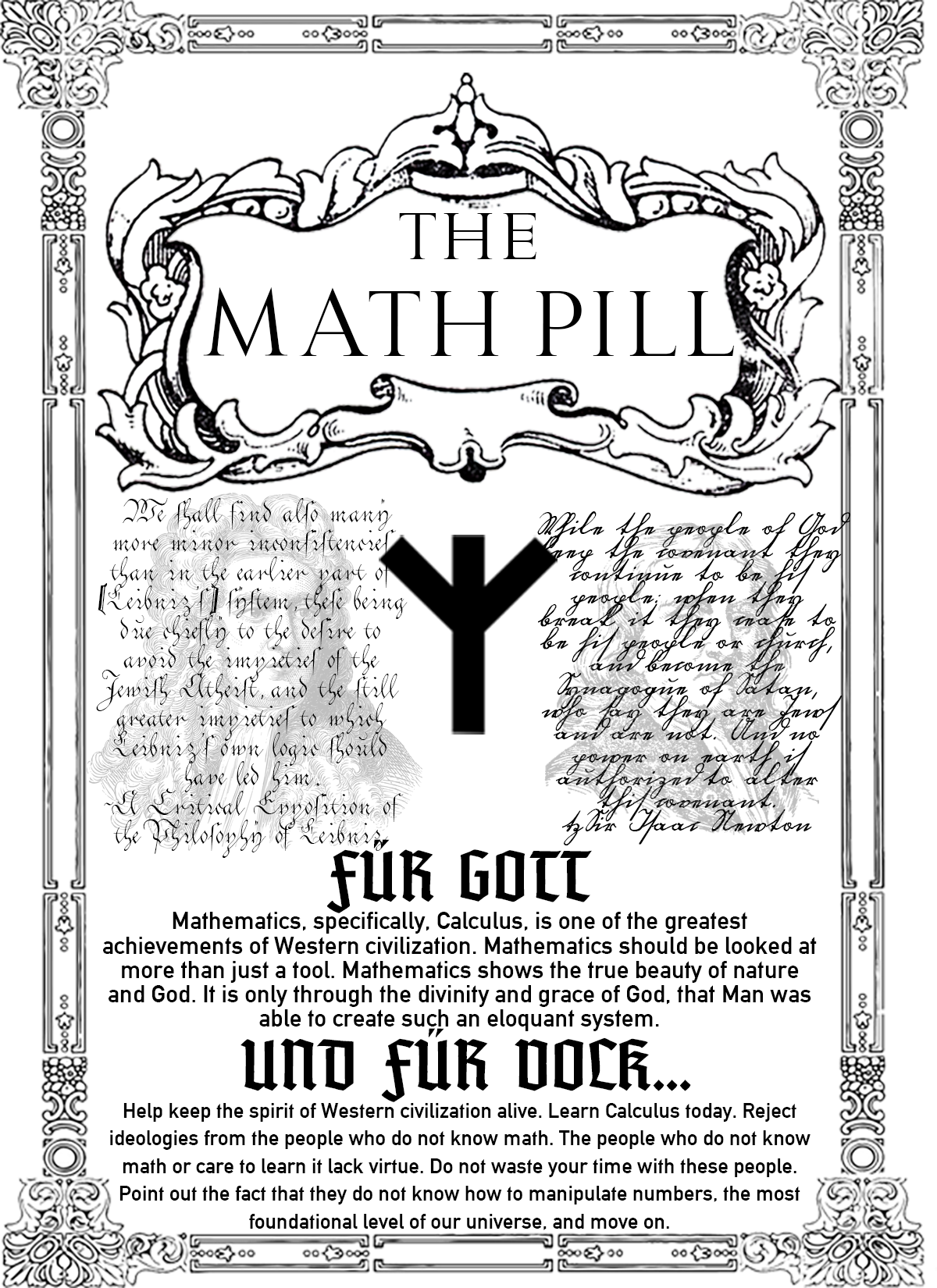
Why haven't you started learning math, anon? Not only does math have practical real world applications, but it will help you in determining what is and isn't true. Without a proper understanding of math you will need to have truth dictated to you by people who do understand. If you really want to be able to uncover truth on your own then you need a proper understanding of math.
/ub/ - Überhengst
Becoming better
32 replies | 24 files | 20 UUIDs | Page 2
>>8813
I have a deep respect for anyone who understands math and is good at it. I, however, am not one of those people and never will be. I've been in and out of college for various reasons off and on for a fair chunk of my adult life, and every time I've gone back I've had to take the same remedial math courses over and over, because I can't pass the math portion of the entrance test (whereas reading comprehension and writing I breeze through with no trouble). We're talking like 8th grade level math, too. I have no idea why, but my head is just like a sieve when it comes to numbers. It takes me forever to learn just enough of it to pass a remedial class, and then I almost instantly forget all of it as soon as I no longer need it. I'm content to leave math to the people who like doing it and have the knack for it. Trying to teach any of it to me is a waste of time.
I have a deep respect for anyone who understands math and is good at it. I, however, am not one of those people and never will be. I've been in and out of college for various reasons off and on for a fair chunk of my adult life, and every time I've gone back I've had to take the same remedial math courses over and over, because I can't pass the math portion of the entrance test (whereas reading comprehension and writing I breeze through with no trouble). We're talking like 8th grade level math, too. I have no idea why, but my head is just like a sieve when it comes to numbers. It takes me forever to learn just enough of it to pass a remedial class, and then I almost instantly forget all of it as soon as I no longer need it. I'm content to leave math to the people who like doing it and have the knack for it. Trying to teach any of it to me is a waste of time.

>>8816
I sincerely believe the best form of government is a math cult. Spirituality, design principles, optimal social organization, ect can all be derived mathematically.
I sincerely believe the best form of government is a math cult. Spirituality, design principles, optimal social organization, ect can all be derived mathematically.
The civilizational progress that can be offered by a society of those who understand advanced mathematical concepts has peaked. There's no more room to grow; no new discoveries to be made.


1753459549_3.png (166.1 KB, 580x425, figure_6be9ac3a1fc02a85ed9adbf493489b76.png)

1753459549_4.jpg (22.6 KB, 327x200, 1-s2.0-S0927776523002308-ga1.jpg)


>>8819
Can you name any recent discoveries? Any math problems that still need to be solved in order to move forward?
Can you name any recent discoveries? Any math problems that still need to be solved in order to move forward?
1753463700.png (45.0 KB, 235x224, 13298B3D23C73202A5F955311BD26CDF-170094.png)



>>8818
>pic related
This is by far one of the most braindead takes I've ever heard on this site. Up there with the flat earthers.
>pic related
This is by far one of the most braindead takes I've ever heard on this site. Up there with the flat earthers.
>>8820
Structural material engineering, computational chemistry, sequencing the human genome and understanding what it all does, fusion reactors, drone engineering, general purpose artificial intelligence, prosthetic limb replacements, reusable rockets, 3D printers, etc. The list goes on.
All of those things are examples of things that have drastically improved in the past couple decades as the math was understood to make them more efficient and feasible, and have enormous potential for development in the next couple decades.
Structural material engineering, computational chemistry, sequencing the human genome and understanding what it all does, fusion reactors, drone engineering, general purpose artificial intelligence, prosthetic limb replacements, reusable rockets, 3D printers, etc. The list goes on.
All of those things are examples of things that have drastically improved in the past couple decades as the math was understood to make them more efficient and feasible, and have enormous potential for development in the next couple decades.
>>8820
>Can you name any recent discoveries?
The hush complex and its implications on horizontal gene transfer.
>Any math problems that still need to be solved in order to move forward?
The game theory involved in selecting which foreign genetic to integrate and keep silent.
>Can you name any recent discoveries?
The applications of fungi im sensing, computing, and self assembling materials.
>Any math problems that still need to be solved in order to move forward?
Several problems in game theory, fuzzy set theory, and fractal geometry to allow us to fully utilize these materials.
>Can you name any recent discoveries?
The nanomateriald and particles ubiquitous in nature that could have very important uses in the real world.
>Any math problems that still need to be solved in order to move forward?
Work still needs to be done in fractal geometry, game theory, and statistical interpretations of quantum mechanics
>Can you name any recent discoveries?
The similarities between slime molds food seeking and city design
>Any math problems that still need to be solved in order to move forward?
Again it would be more game theory math
>Can you name any recent discoveries?
All kinds of advances in immunotherapy
>Any math problems that still need to be solved in order to move forward?
Much work to be done in topology, optimization theory, and again game theory (similar reasons as the hush complex)
And before you ask for specific equations, I cant really give you an answer there. We don't know what we don't know. I can tell you that models are incomplete though. Also think of how much we use complex numbers and imaginary numbers. That math was all done by people picking around for fun same with knot theory.
>Can you name any recent discoveries?
The hush complex and its implications on horizontal gene transfer.
>Any math problems that still need to be solved in order to move forward?
The game theory involved in selecting which foreign genetic to integrate and keep silent.
>Can you name any recent discoveries?
The applications of fungi im sensing, computing, and self assembling materials.
>Any math problems that still need to be solved in order to move forward?
Several problems in game theory, fuzzy set theory, and fractal geometry to allow us to fully utilize these materials.
>Can you name any recent discoveries?
The nanomateriald and particles ubiquitous in nature that could have very important uses in the real world.
>Any math problems that still need to be solved in order to move forward?
Work still needs to be done in fractal geometry, game theory, and statistical interpretations of quantum mechanics
>Can you name any recent discoveries?
The similarities between slime molds food seeking and city design
>Any math problems that still need to be solved in order to move forward?
Again it would be more game theory math
>Can you name any recent discoveries?
All kinds of advances in immunotherapy
>Any math problems that still need to be solved in order to move forward?
Much work to be done in topology, optimization theory, and again game theory (similar reasons as the hush complex)
And before you ask for specific equations, I cant really give you an answer there. We don't know what we don't know. I can tell you that models are incomplete though. Also think of how much we use complex numbers and imaginary numbers. That math was all done by people picking around for fun same with knot theory.
>>8820
>Can you name any recent discoveries?
Gravitational waves, for starters.
>Any math problems that still need to be solved in order to move forward?
1. Navier-Stokes Equations and the smoothness problem: relevant for aerodynamics, hydrodynamics, and weather prediction.
2. P vs NP Problem: relevant to computer algorithm optimization and cryptography.
3. 3. Yang-Mills Existence and Mass Gap: relevant to material engineering and nuclear energy production.
>Can you name any recent discoveries?
Gravitational waves, for starters.
>Any math problems that still need to be solved in order to move forward?
1. Navier-Stokes Equations and the smoothness problem: relevant for aerodynamics, hydrodynamics, and weather prediction.
2. P vs NP Problem: relevant to computer algorithm optimization and cryptography.
3. 3. Yang-Mills Existence and Mass Gap: relevant to material engineering and nuclear energy production.
>>8827
>making ponies real
Genetic engineering: requires math.
I mentioned genome sequencing, which is important if you want your ponies to actually be ponies and not just techinolor horses.
>racial extinguishment
Race-specific bioweapons. See above. You're going to want to get your sequencing right it you use this.
>better game graphics
I already mentioned computer optimization.
>Phrase not found
Learn to read before you ask about math.
>making ponies real
Genetic engineering: requires math.
I mentioned genome sequencing, which is important if you want your ponies to actually be ponies and not just techinolor horses.
>racial extinguishment
Race-specific bioweapons. See above. You're going to want to get your sequencing right it you use this.
>better game graphics
I already mentioned computer optimization.
>Phrase not found
Learn to read before you ask about math.

>>8813
>Why haven't you started learning math, anon?
F
I was trying to learn a Topology book and I gave up. It is way above my paygrade.
>Why haven't you started learning math, anon?
F
I was trying to learn a Topology book and I gave up. It is way above my paygrade.


Whenever you tell people to learn math, many bristle and ask: 'What use are derivatives or integrals to me?' The short answer: quite a lot. You don't need to compute complicated formulas to benefit, you only need to grasp the ideas. Those ideas train you to think clearly about change, accumulation, scale, dependence and structure, and that kind of clarity helps in everyday decisions and social judgment.
A derivative is simply a measure of change: how fast something moves, grows, or reacts when a driving factor moves a little. If you understand slopes and rates, you can read the state of a system and make better short-term predictions or interventions.
An integral is the complementary idea: accumulation. It tells you the total effect accumulated over a range, the "area under the curve". That perspective is exactly what you need to see indirect or cumulative consequences.
Limits reveal the skeleton of an idea. Pushing a parameter to its boundary (or to infinity) shows where a line of reasoning ultimately lands, whether it converges to a useful conclusion or blows up into nonsense.
Logarithms let you compare vastly different magnitudes on a single scale. They also show how easily perception can be distorted by scale, and how to avoid being misled by comparisons that hide real proportions.
Functions formalize dependence: which variables follow from which, and which are independent. Spotting misplaced dependence is a key way to detect fallacies, people often present two unrelated variables as if one caused the other.
Algebra teaches you that understanding many situations requires solving systems: multiple measurements, multiple unknowns, and an assessment of how constrained your conclusions are. The degree of the problem and the balance of knowns-to-unknowns tell you how much confidence to place in a result.
Number theory reminds us that structure and simple principles can let you predict or rule out possibilities before you ever see the data or experience it.
Game theory is essentially what we call politics!
Graphs and plots are among the most practical tools: they make relationships visible, help you optimize, and reveal connections between people, events, or variables.
Geometry underpins how we perceive and act in a three-dimensional world. It may feel concrete and practical, but it rests on rigorous, logical reasoning.
You might think this is overexplaining, that we already live by intuitive math without calling it that. True, the problem is we often prefer emotion over logic and tell ourselves 'maybe this time is different'. Mathematics keeps us honest: once a principle is tested and understood, it's harder to dismiss inconsistently later. It exposes the irrational parts of our thinking and guides us to clearer definitions and conclusions.
If that sounds nonsense, I'll illustrate with two concrete examples:
Imagine a situation in which an event occurs that could harm you, if people talk about it, or worse, believe it.Why did Epstein suddenly come to mind?
Your instinct might be to reduce its weight: present it as trivial, meaningless, or simply as rumor.
How? The mechanism is straightforward. You mobilize a network of bots and a handful of high-follower accounts. Together, they form a chain of repetition. Each retelling reduces the perceived seriousness of the story by just 1%. And at key points in the chain, the high-follower accounts broadcast it to wide audiences, multiplying the effect.
Mathematically, we can model this as follows: if event α occurs and is passed through x accounts, the final perception is f(x) = α.(0.99)^x
In words: the story's weight decays exponentially with each transmission. A mere 1% reduction per step may seem insignificant, but that is precisely why it succeeds: no single person notices the minimization. Nor do most people trace the chain back to its source. They simply accept the diluted version.
The numbers are striking. With only 1000 bot accounts and about 10 prominent influencers, the story's weight can be driven down to just 0.000043 of its original impact, essentially noise. Of course, others may try to exaggerate events, but this mechanism works both ways: amplification is just the inverse process.
Now let us shift to a different but related lesson, drawn not from social media but from geometry.
Consider the "staircase paradox". We take a right triangle with legs of length 1. By pythagoras, the hypotenuse should have length sqrt(2). Yet we can approximate the hypotenuse with a staircase path: one unit over, one unit up, repeated many times. Its total length is always 2. As we make the steps smaller and smaller, the staircase appears to converge to the hypotenuse. And so, if we reason naively, we arrive at the absurd conclusion that sqrt(2)=2 !
Where is the mistake? The staircase converges pointwise: each individual step lies arbitrarily close to the hypotenuse. But there is no uniform convergence: the length of the whole path never converges to the length of the hypotenuse. Infinitely many "locally correct" approximations do not add up to a globally correct one.
This gives us a sharp social analogue. If many individuals each distort the truth only slightly (say by 1%) we cannot assume the sum of distortions is still "acceptable". Quite the opposite: the accumulation yields a completely false conclusion. Truth is fragile: countless small twists can turn it into its opposite.
It's true that these mathematical models are simplified and idealized versions of reality, but their structure and underlying concept are the same.
Both examples (the exponential decay of rumor and the paradox of the staircase) show how mathematics reveals deep lessons. Even small, almost invisible manipulations, whether in discourse or in reasoning, can compound into a distortion so great that it destroys the original truth.
As my math professor said: 'The whole world is based on functions, we just haven't discovered the rules for some of them yet…'
A derivative is simply a measure of change: how fast something moves, grows, or reacts when a driving factor moves a little. If you understand slopes and rates, you can read the state of a system and make better short-term predictions or interventions.
An integral is the complementary idea: accumulation. It tells you the total effect accumulated over a range, the "area under the curve". That perspective is exactly what you need to see indirect or cumulative consequences.
Limits reveal the skeleton of an idea. Pushing a parameter to its boundary (or to infinity) shows where a line of reasoning ultimately lands, whether it converges to a useful conclusion or blows up into nonsense.
Logarithms let you compare vastly different magnitudes on a single scale. They also show how easily perception can be distorted by scale, and how to avoid being misled by comparisons that hide real proportions.
Functions formalize dependence: which variables follow from which, and which are independent. Spotting misplaced dependence is a key way to detect fallacies, people often present two unrelated variables as if one caused the other.
Algebra teaches you that understanding many situations requires solving systems: multiple measurements, multiple unknowns, and an assessment of how constrained your conclusions are. The degree of the problem and the balance of knowns-to-unknowns tell you how much confidence to place in a result.
Number theory reminds us that structure and simple principles can let you predict or rule out possibilities before you ever see the data or experience it.
Game theory is essentially what we call politics!
Graphs and plots are among the most practical tools: they make relationships visible, help you optimize, and reveal connections between people, events, or variables.
Geometry underpins how we perceive and act in a three-dimensional world. It may feel concrete and practical, but it rests on rigorous, logical reasoning.
You might think this is overexplaining, that we already live by intuitive math without calling it that. True, the problem is we often prefer emotion over logic and tell ourselves 'maybe this time is different'. Mathematics keeps us honest: once a principle is tested and understood, it's harder to dismiss inconsistently later. It exposes the irrational parts of our thinking and guides us to clearer definitions and conclusions.
If that sounds nonsense, I'll illustrate with two concrete examples:
Imagine a situation in which an event occurs that could harm you, if people talk about it, or worse, believe it.Why did Epstein suddenly come to mind?
Your instinct might be to reduce its weight: present it as trivial, meaningless, or simply as rumor.
How? The mechanism is straightforward. You mobilize a network of bots and a handful of high-follower accounts. Together, they form a chain of repetition. Each retelling reduces the perceived seriousness of the story by just 1%. And at key points in the chain, the high-follower accounts broadcast it to wide audiences, multiplying the effect.
Mathematically, we can model this as follows: if event α occurs and is passed through x accounts, the final perception is f(x) = α.(0.99)^x
In words: the story's weight decays exponentially with each transmission. A mere 1% reduction per step may seem insignificant, but that is precisely why it succeeds: no single person notices the minimization. Nor do most people trace the chain back to its source. They simply accept the diluted version.
The numbers are striking. With only 1000 bot accounts and about 10 prominent influencers, the story's weight can be driven down to just 0.000043 of its original impact, essentially noise. Of course, others may try to exaggerate events, but this mechanism works both ways: amplification is just the inverse process.
Now let us shift to a different but related lesson, drawn not from social media but from geometry.
Consider the "staircase paradox". We take a right triangle with legs of length 1. By pythagoras, the hypotenuse should have length sqrt(2). Yet we can approximate the hypotenuse with a staircase path: one unit over, one unit up, repeated many times. Its total length is always 2. As we make the steps smaller and smaller, the staircase appears to converge to the hypotenuse. And so, if we reason naively, we arrive at the absurd conclusion that sqrt(2)=2 !
Where is the mistake? The staircase converges pointwise: each individual step lies arbitrarily close to the hypotenuse. But there is no uniform convergence: the length of the whole path never converges to the length of the hypotenuse. Infinitely many "locally correct" approximations do not add up to a globally correct one.
This gives us a sharp social analogue. If many individuals each distort the truth only slightly (say by 1%) we cannot assume the sum of distortions is still "acceptable". Quite the opposite: the accumulation yields a completely false conclusion. Truth is fragile: countless small twists can turn it into its opposite.
It's true that these mathematical models are simplified and idealized versions of reality, but their structure and underlying concept are the same.
Both examples (the exponential decay of rumor and the paradox of the staircase) show how mathematics reveals deep lessons. Even small, almost invisible manipulations, whether in discourse or in reasoning, can compound into a distortion so great that it destroys the original truth.
As my math professor said: 'The whole world is based on functions, we just haven't discovered the rules for some of them yet…'
1755578169.png (1.1 MB, 1440x805, 0A4CE668BFA4657AD7328D3395D28B2D-1151557.png)


Anyone here going into STEM? I think I might go back for my master's.
Who wants to learn some math and science? I want to go over some topics in math and chemistry and having someone to tutor will help me refresh.
>>8920
Basic Ochem and I want to learn inorganic. I can start with stoichiometry if you need the basics though.
[email protected]
Basic Ochem and I want to learn inorganic. I can start with stoichiometry if you need the basics though.
[email protected]
1760761459_1.jpg (898.8 KB, 1920x1440, Photo_2025-10-17 23_22_52_799.JPG)

1760761459_2.jpg (1.2 MB, 1920x1440, Photo_2025-10-17 23_22_29_879.JPG)

1760761459_3.jpg (814.3 KB, 1920x1440, Photo_2025-10-17 23_21_42_349.JPG)

1760761459_4.jpg (793.3 KB, 1920x1440, Photo_2025-10-17 23_21_06_393.JPG)

1760761459_5.jpg (919.5 KB, 1920x1440, Photo_2025-10-17 23_22_16_584.JPG)

>>8921
>>8922
Well, no, I've actually read Solomons myself (though I've forgotten many of the more specific reactions that weren't really relevant to my field).
Thanks for your suggestion.
If you're planning to study inorganic chem, I'd recommend Housecroft if you're a beginner, but Miessler if you already have some background. Although honestly, if you've got enough time, I would say read both, they complement each other really well.
Btw, don't you have any particular recommendations for descriptive chemistry? I've always been looking for a relatively comprehensive reference on that topic. Most professors just used their own notes, but I'd prefer a solid textbook.
Also, unfortunately, I can't contact you on telegram, it's kind of a personal rule for keeping my anon status.
Either way, I appreciate your offer.
P.S: Also, sorry for the delay in replying, I had class.
>>8922
Well, no, I've actually read Solomons myself (though I've forgotten many of the more specific reactions that weren't really relevant to my field).
Thanks for your suggestion.
If you're planning to study inorganic chem, I'd recommend Housecroft if you're a beginner, but Miessler if you already have some background. Although honestly, if you've got enough time, I would say read both, they complement each other really well.
Btw, don't you have any particular recommendations for descriptive chemistry? I've always been looking for a relatively comprehensive reference on that topic. Most professors just used their own notes, but I'd prefer a solid textbook.
Also, unfortunately, I can't contact you on telegram, it's kind of a personal rule for keeping my anon status.
Either way, I appreciate your offer.
P.S: Also, sorry for the delay in replying, I had class.